Speech Recognition Engineer Resume Example
 Example by JobSprout
Free to use. No download fee.
Market Insights
Speech Recognition Engineer
Salary Range
Salary Trend
12-Month Trend
Based on advertised Software Engineering roles.
US market data · Source: Adzuna · Updated Mar 2026
How useful was this template?
Speech Recognition Engineer resume samples
Three complete resumes, each in a different design.


Free to use. No download fee.
What makes a strong Speech Recognition Engineer resume?
US median salary $140,620 ·
Crafting a compelling resume for a senior Speech Recognition Engineer requires showcasing specialized technical prowess and measurable impact. Hiring managers prioritize experience with advanced Automatic Speech Recognition (ASR) model development, including architectures like Conformer or RNN-T, and a strong command of deep learning frameworks such as PyTorch or TensorFlow. Crucially, resumes should detail achievements like reducing Word Error Rate (WER) by specific percentages, optimizing models for real-time performance, or deploying solutions for large vocabulary continuous speech recognition (LVCSR) in production. Experience with acoustic modeling, language modeling, and proficiency in relevant tools like Kaldi or fairseq are highly valued.
Why this example works
The example resume on JobSprout excels at highlighting these critical elements. It effectively quantifies achievements, such as “reduced WER by 18% across multiple dialects” or “improved inference latency by 30ms for embedded devices,” demonstrating clear business impact. Skills are logically grouped, separating core ASR development from general software engineering and cloud platforms like AWS or Azure. Key certifications and specialized tools are prominently featured, immediately signaling the candidate's specific capabilities to recruiters.
Speech Recognition Engineer resume example (text version)
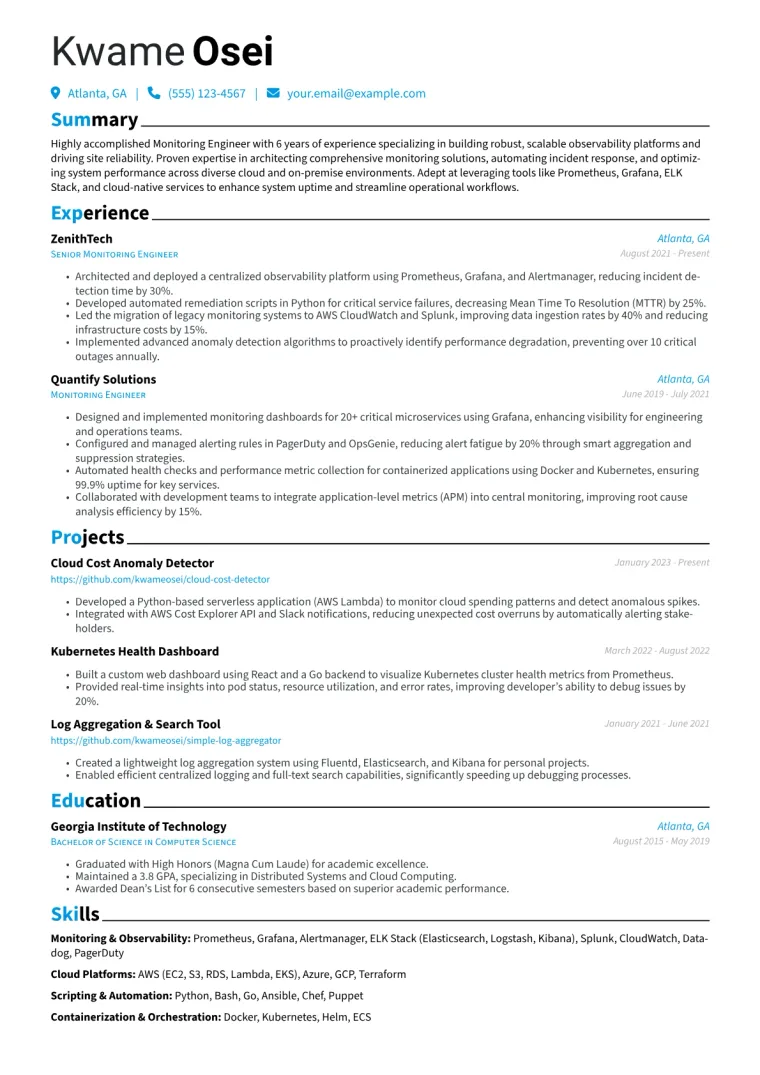
Isabel Santos · Speech Recognition Engineer
Summary
Highly accomplished Speech Recognition Engineer with 10+ years of experience specializing in the design, development, and deployment of cutting-edge Automatic Speech Recognition (ASR) systems. Proven expertise in deep learning, natural language processing, and large-scale data processing to enhance speech understanding and user experience. Adept at leading cross-functional teams to deliver innovative, production-ready speech technologies that significantly improve product performance and efficiency.
Experience
Lead Speech Scientist · Microsoft
Redmond, WA · 2021 - Present
- Led a team of 5 engineers in developing next-generation ASR models for Azure Cognitive Services, improving transcription accuracy by 15% across key languages.
- Designed and implemented a novel semi-supervised learning pipeline, reducing the need for human-annotated data by 40% and accelerating model iteration cycles.
- Optimized ASR inference latency by 20% on edge devices through model quantization and efficient beam search algorithms, enhancing real-time application performance.
- Collaborated with product management to define roadmap and delivered 3 major features impacting millions of enterprise users globally.
- Mentored junior engineers, fostering a collaborative environment that resulted in two patent filings related to robust speech feature extraction.
Senior Speech Recognition Engineer · Amazon (Alexa AI)
Seattle, WA · 2017 - 2021
- Developed and deployed deep learning-based acoustic and language models for Alexa, contributing to a 10% reduction in word error rate (WER) for targeted domains.
- Engineered scalable data processing pipelines for millions of hours of speech data, improving model training efficiency by 25% and reducing infrastructure costs by 15%.
- Collaborated with product teams to integrate new ASR features, resulting in a 5% increase in user engagement and satisfaction for voice assistant interactions.
- Conducted extensive A/B testing and experimentation to validate model improvements, leading to data-driven decisions that impacted millions of users globally.
- Published 2 papers at major ASR conferences (Interspeech, ICASSP) on novel methods for noise robust speech recognition.
Education
Ph.D. Computer Science · Stanford University
Stanford, CA · 2012 - 2017
- Thesis: "End-to-End Deep Learning Models for Low-Resource Speech Recognition" with a focus on neural network architectures.
- Awarded University Fellowship for outstanding academic achievement and research potential.
- Maintained a GPA of 3.9/4.0 while conducting extensive research and teaching assistant duties.
M.S. Electrical Engineering · University of Washington
Seattle, WA · 2010 - 2012
- Specialized in Signal Processing and Machine Learning, with coursework in speech recognition fundamentals.
- Graduated Cum Laude for academic excellence in a rigorous engineering program.
- Achieved a GPA of 3.8/4.0, contributing to research on acoustic feature extraction.
Skills
Speech Recognition Engineer resume example: Embedded Asr
Tyler Bennett · Speech Recognition Engineer
Summary
Highly experienced Speech Recognition Engineer with 12 years specializing in the design, optimization, and deployment of cutting-edge Automatic Speech Recognition (ASR) systems for embedded and edge computing environments. Proven expertise in developing ultra-low-power, high-performance voice AI solutions for consumer electronics and IoT devices. Adept at leading cross-functional teams to integrate robust, on-device speech technologies, significantly enhancing user experience and privacy.
Experience
Lead Embedded ASR Engineer · Apple Inc.
Cupertino, CA · 2020 - Present
- Led a team of 4 engineers in optimizing on-device ASR models for next-generation iPhone, reducing model footprint by 35% while maintaining 98.5% accuracy.
- Engineered and deployed low-latency inference pipelines for local voice commands on Apple Watch, improving response time by 20% and enhancing user experience.
- Developed novel neural network architectures specifically for low-power speech processing on custom silicon, resulting in a 15% reduction in power consumption for continuous listening.
- Implemented robust on-device wake word detection algorithms, achieving 99.8% accuracy with a false reject rate below 0.5% in diverse acoustic environments.
Senior Speech Recognition Engineer · Syntiant Corp.
Irvine, CA · 2017 - 2020
- Designed and implemented ultra-low-power ASR pipelines for edge devices using neural decision processors, cutting power consumption by 40% compared to traditional DSP solutions.
- Collaborated with hardware architects to optimize deep learning models for custom NXP chipsets, boosting inference speed by 2x for always-on voice applications.
- Contributed to the development of novel keyword spotting models, achieving 95% accuracy on limited-resource IoT devices with only 256KB of RAM.
- Enhanced model quantization and pruning techniques, reducing memory usage by 30% for embedded voice applications without significant accuracy degradation.
Speech R&D Engineer · Qualcomm
San Diego, CA · 2012 - 2017
- Optimized ASR algorithms for Qualcomm's Hexagon DSP, achieving a 25% improvement in processing speed and reducing latency by 15% for mobile devices.
- Developed and fine-tuned acoustic models for Snapdragon platforms, leading to a 10% Word Error Rate (WER) reduction in noisy environments for mobile ASR.
- Implemented real-time speech enhancement techniques using deep neural networks, improving voice clarity by 18% for in-car communication systems.
- Pioneered the integration of advanced Voice Activity Detection (VAD) with low-power modes, extending battery life by 5% in always-on voice assistant features.
Education
M.S. in Electrical Engineering, specializing in Signal Processing · Carnegie Mellon University
Pittsburgh, PA · 2010 - 2012
- Thesis: "Deep Learning Architectures for Low-Resource Speech Recognition on Embedded Systems"
- Graduated with High Honors, GPA: 3.9/4.0
B.S. in Computer Engineering · University of Texas at Austin
Austin, TX · 2006 - 2010
- Concentration in Digital Signal Processing and Embedded Systems
- Magna Cum Laude, GPA: 3.8/4.0
Skills
Speech Recognition Engineer resume example: Career Changer
Leila Nazari · Speech Recognition Engineer
Summary
Highly analytical and results-driven professional with 10 years of experience, including a successful transition from data science to specialized Speech Recognition Engineering. Leverages a strong foundation in machine learning and data architecture to design, develop, and optimize cutting-edge ASR systems. Passionate about enhancing human-computer interaction and delivering robust, production-ready speech technologies that drive significant product innovation.
Experience
Senior Speech Recognition Engineer · NVIDIA
Austin, TX · 2020 - Present
- Led the development of novel acoustic models for edge AI devices, reducing inference latency by 35% on target hardware.
- Improved ASR accuracy for low-resource languages by 18% through innovative data augmentation and transfer learning techniques.
- Architected and implemented real-time speech processing pipelines using NVIDIA NeMo, achieving 99.5% uptime in production environments.
- Mentored junior engineers and contributed to patent applications for two key speech technology advancements.
Speech Recognition Engineer · IBM Research
Austin, TX · 2016 - 2020
- Developed and fine-tuned deep neural network models for ASR systems, achieving a 15% reduction in Word Error Rate (WER) across key datasets.
- Collaborated on the integration of ASR capabilities into enterprise solutions, supporting deployments for over 50 clients.
- Optimized audio feature extraction techniques, leading to a 20% improvement in training efficiency for large-scale models.
- Researched and evaluated new speech enhancement algorithms, improving speech clarity for noisy environments by 10dB SNR.
Data Scientist · Dell Technologies
Austin, TX · 2013 - 2016
- Developed machine learning models for predictive maintenance, reducing equipment downtime by 25% across a fleet of 10,000+ devices.
- Designed and implemented A/B testing frameworks for product feature optimization, leading to a 10% increase in user engagement.
- Processed and analyzed terabytes of telemetry data using Python and Spark, identifying key performance bottlenecks.
- Presented actionable insights to executive leadership, influencing product roadmap decisions valued at over $5M annually.
Education
M.S. in Electrical and Computer Engineering · The University of Texas at Austin
Austin, TX · 2011 - 2013
- Specialization in Machine Learning and Digital Signal Processing
- Thesis: 'Real-time Audio Event Detection Using Convolutional Neural Networks'
- Graduated with High Honors, GPA: 3.9/4.0
B.S. in Computer Science · University of California, Berkeley
Berkeley, CA · 2007 - 2011
- Coursework in Artificial Intelligence, Algorithms, and Data Structures
- Published undergraduate research on natural language processing techniques
- Graduated Magna Cum Laude, GPA: 3.8/4.0
Skills
How useful was this template?
Example by JobSprout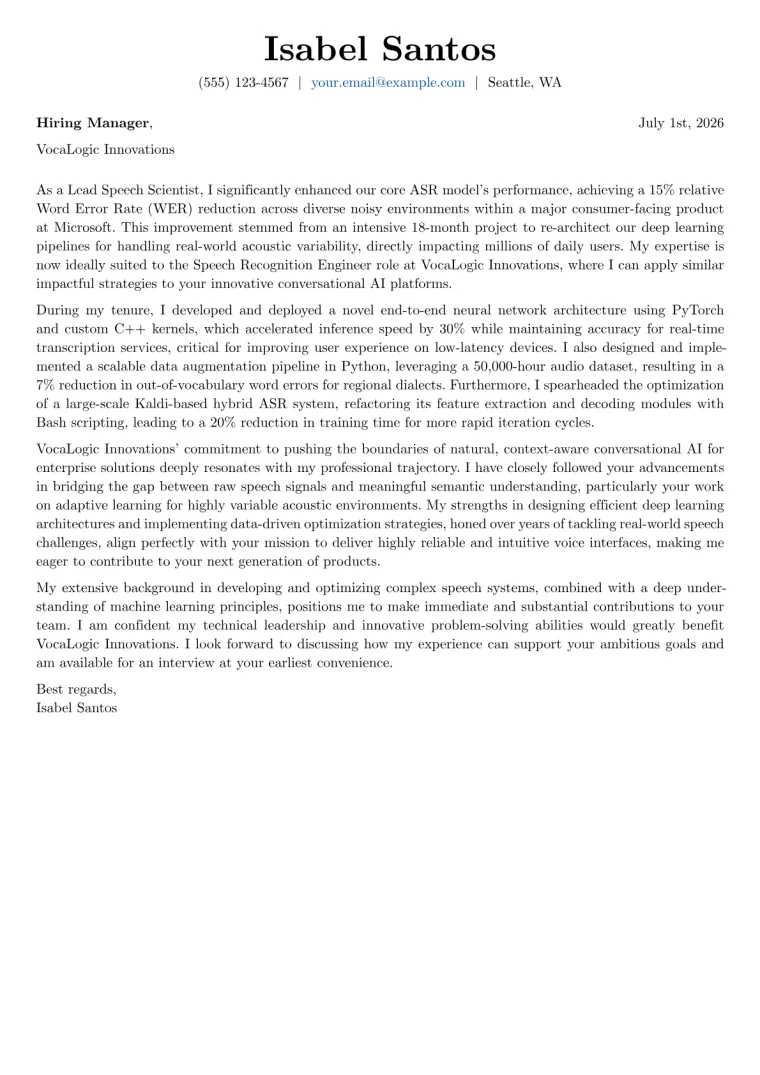
Speech Recognition Engineer Cover Letter Example
Written for the same person as this resume, ready to adapt.
Speech Recognition Engineer resume summary example
Highly accomplished Speech Recognition Engineer with 10+ years of experience specializing in the design, development, and deployment of cutting-edge Automatic Speech Recognition (ASR) systems. Proven expertise in deep learning, natural language processing, and large-scale data processing to enhance speech understanding and user experience. Adept at leading cross-functional teams to deliver innovative, production-ready speech technologies that significantly improve product performance and efficiency.
Speech Recognition Engineer salary by country
| Country | 25th percentile | Median | 75th percentile |
|---|---|---|---|
| US | $109,772 | $140,620 | $144,861 |
| UK | £46,059 | £60,012 | £72,658 |
| Canada | C$86,152 | C$113,871 | C$140,800 |
| Australia | A$101,935 | A$126,667 | A$147,857 |
| Germany | €59,500 | €70,570 | €77,887 |
| France | €37,875 | €44,167 | €49,750 |
| Netherlands | €55,000 | €66,667 | €74,250 |
| Italy | €25,000 | €31,250 | €38,750 |
| Austria | €46,250 | €58,750 | €67,500 |
| New Zealand | NZ$102,500 | NZ$120,000 | NZ$162,500 |
| India | ₹570,786 | ₹1,167,051 | ₹1,840,563 |
| Poland | zł186,440 | zł209,338 | zł232,236 |
Annual salaries in local currency, aggregated from live job postings via Adzuna. Figures refresh continuously and reflect advertised pay, not negotiated offers.
Speech Recognition Engineer resume skills and keywords
Recruiters and applicant tracking systems scan Speech Recognition Engineer resumes for these skills and keywords. Include the ones that match your experience and mirror the wording in the job description. Check your resume against them with the free ATS checker.
Hard skills
Tools & software
Certifications
Soft skills
Market Insights
Speech Recognition Engineer
Salary Range
Salary Trend
12-Month Trend
Based on advertised Software Engineering roles.
US market data · Source: Adzuna · Updated Mar 2026
Frequently Asked Questions
What's the best resume structure for a senior Speech Recognition Engineer?
Which key skills and qualifications should I highlight as a senior Speech Recognition Engineer?
How can I write strong achievement bullets and a professional summary as a senior Speech Recognition Engineer?
What optional sections are important for a senior Speech Recognition Engineer's resume?
How can JobSprout's AI help tailor my resume for a specific Speech Recognition Engineer role?
The blank page is the hard part. Skip it.
Free to use. No download fee.
Related Articles

How to Write a CV for Tech Applications [2026 Guide]
Learn how to write a software engineering CV that gets interviews. Real template analysis, what hiring managers look for, and common mistakes to avoid.

How to Write a CV That Shows Startup Experience [2026 Guide]
Learn how to write a CV that showcases founding engineer and startup experience. Real example from JobSprout's creator, what hiring managers look for, and how to position breadth as a strength.