PDF or DOCX · up to 2MB
Short cover letters get read. Here are 5 proven templates under 150 words, with examples for experienced professionals, career changers, and graduates.
Write a prompt engineer resume that gets interviews. Full resume example, summary templates, 10+ experience bullets, technical skills breakdown, and tips for career changers from software engineering, copywriting, data science, and UX research.
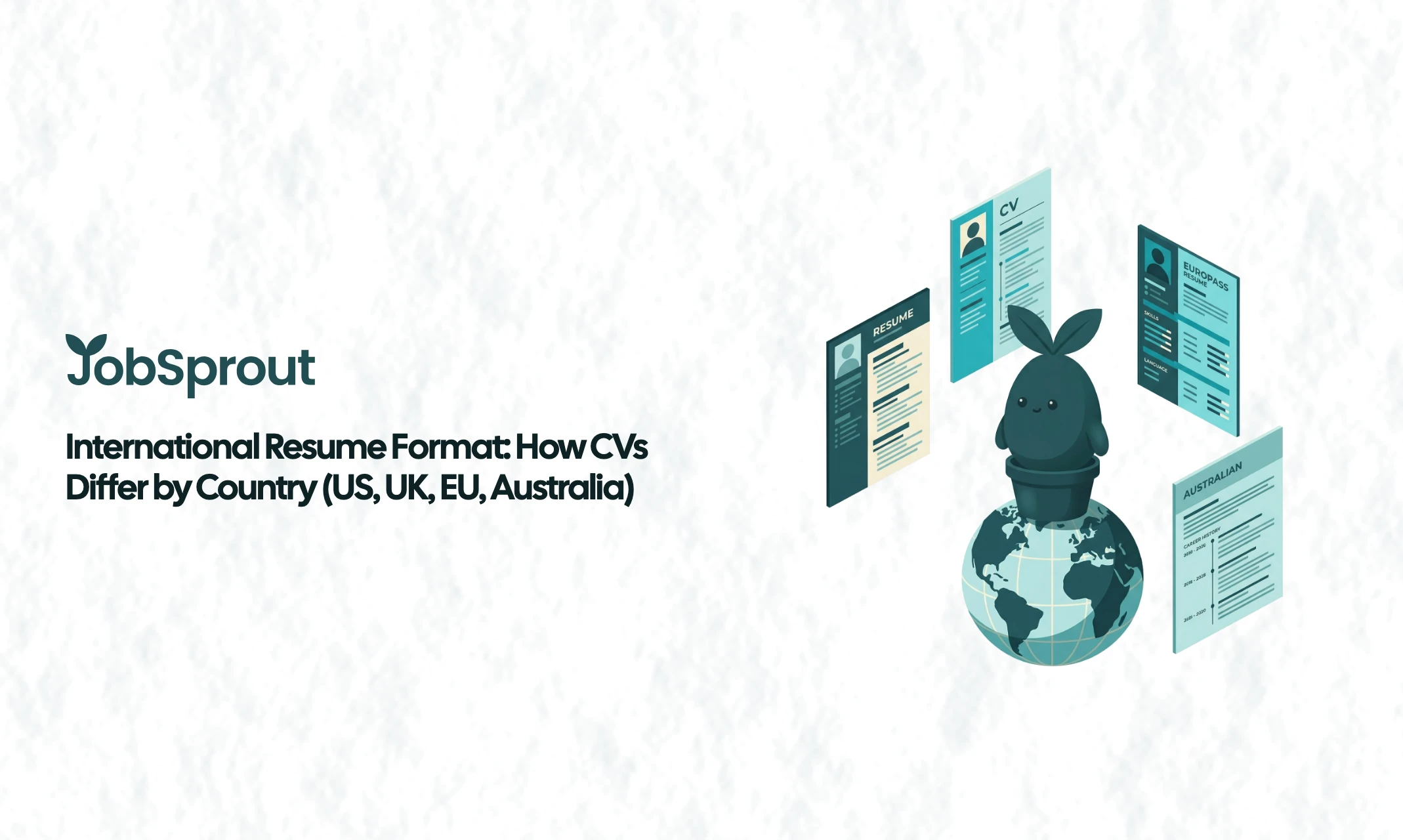
Learn how resume and CV formats differ across countries. Covers the US, UK, Germany, France, Australia, Japan, and the Middle East with comparison tables and practical tips.
Learn how to write a resume for an internal transfer. Includes a full example, summary templates for lateral moves, promotions and department changes, weak vs strong comparisons, and advice on navigating the politics.
The average cover letter is 350 words. The average time a hiring manager spends reading one is under 30 seconds.
That mismatch tells you everything you need to know. Most cover letters are too long, too generic, and too full of filler to survive the initial scan. A 2024 ResumeGo study found that cover letters between 200 and 250 words received significantly more interview callbacks than longer alternatives. Survey after survey of hiring professionals confirms: most prefer a cover letter that fits on half a page or less.
The good news: writing a shorter cover letter is actually easier than writing a long one, once you know what to include and what to cut.
This guide gives you five complete cover letter templates, all under 150 words. Each one is tailored for a different situation: experienced professionals, results-driven roles, culture-fit applications, career changers, and new graduates. Copy them, adapt them, and start getting more responses.
There is a persistent myth that longer cover letters show more effort and dedication. In practice, the opposite is true. Here is what the data tells us:
Reading time is brutal. Eye-tracking research suggests recruiters spend roughly 6 to 7 seconds on an initial document scan. Your cover letter needs to deliver its message in that window, or risk being skipped entirely.
Completion rates drop with length. When a hiring manager opens a cover letter and sees a wall of text, the most common response is to jump straight to the CV. A concise letter that fits in one visible screen gets read start to finish. A long one gets skimmed, at best.
Short letters signal confidence. Anyone can ramble for 400 words about their "passion for the industry." It takes genuine clarity to distil your value into three tight paragraphs. Hiring managers notice the difference.
Recruiters are multitasking. The average recruiter handles 30 to 40 open roles simultaneously. They are reviewing your cover letter between meetings, on their phone, or while triaging 200 other applications. Respecting their time is not just polite, it is strategic.
The takeaway is simple: say less, say it well, and let your CV do the heavy lifting on the details.
Every effective short cover letter follows the same three-paragraph structure. Think of it as Hook, Value, Close.
Open with something specific. Name the role, name the company, and give one reason you are writing beyond "I saw your job posting." This paragraph should be two to three sentences maximum.
Good: "I am applying for the Senior Data Analyst role at Monzo. Having spent four years building fraud detection models at Starling Bank, I am drawn to the scale of Monzo's transaction data and the problems your analytics team is solving."
Bad: "I am writing to express my interest in the position advertised on your website. I believe my skills and experience make me a strong candidate for this role."
The first version is specific, credentialed, and shows genuine knowledge of the company. The second could be pasted into any application for any role at any company.
This is your one-shot pitch. Pick the single most relevant achievement or qualification and connect it directly to what the role requires. Use a number if you can. This is not the place to summarise your entire career, it is the place to make one irresistible point.
Good: "In my current role, I reduced false-positive fraud alerts by 34%, saving the operations team approximately 120 hours per month. I would bring that same focus on measurable impact to Monzo's risk analytics function."
Bad: "I have experience with SQL, Python, R, Tableau, Power BI, Excel, and various other analytical tools. I am also a strong communicator and team player."
End with a clear, confident call to action. No grovelling, no "I would be eternally grateful for the opportunity." State what you want (an interview), express genuine interest, and sign off.
Good: "I would welcome the chance to discuss how my experience with large-scale fraud analytics could support Monzo's growth. I am available for a conversation at your convenience."
Bad: "I really hope you will consider my application. I know there are many qualified candidates, but I truly believe I could be a good fit. Please do not hesitate to contact me."
That is it. Three paragraphs, under 150 words, each one doing a specific job. If you want a deeper dive into cover letter structure, our complete guide on how to write a cover letter covers every element in detail.
Each template below is a complete, ready-to-adapt cover letter. They use realistic details, specific companies, and genuine-sounding achievements. Swap in your own details and you have a finished letter.
Best for: Experienced professionals with clear, relevant experience for the target role.
When to use it: When your background is a strong match and you do not need to explain any gaps, transitions, or unusual circumstances. Let your track record speak.
Dear Hiring Manager,
I am writing to apply for the Operations Manager position at Sainsbury's. With eight years of experience managing warehouse operations for Tesco, I have a strong understanding of the pace and complexity of UK grocery retail logistics.
In my current role, I oversee a team of 45 across two distribution centres and have reduced order fulfilment errors by 28% over the past year through a revised quality-check process. I am confident I can bring that same operational discipline to your Bromley distribution hub.
I would welcome the opportunity to discuss how my experience aligns with your team's goals. I have attached my CV for your review.
Kind regards, Sarah Mitchell
Word count: 118
Why it works:
Best for: Results-driven roles in sales, marketing, business development, or any position where numbers matter more than narratives.
When to use it: When you have a standout metric that directly relates to what the hiring company needs. Lead with your best number and build outward.
Dear Hiring Manager,
Last year, I grew my territory's revenue from £1.2M to £1.9M as a Regional Sales Manager at Vodafone. I am now looking to bring that growth-focused approach to the Business Development Lead role at BT.
My approach centres on building long-term client relationships rather than chasing short-term wins. At Vodafone, this meant an 87% client retention rate alongside the revenue growth, something I know matters in telecoms where acquisition costs are high.
I would love to discuss how I could contribute to BT's enterprise sales strategy. My CV is attached with further details.
Kind regards, James Okafor
Word count: 113
Why it works:
Best for: Roles where cultural fit and mission alignment matter as much as technical skills, such as startups, non-profits, B Corps, and purpose-driven organisations.
When to use it: When you genuinely care about what the company does and can articulate why. This template falls flat if the connection is not authentic, so only use it when you mean it.
Dear Hiring Manager,
I have been following Octopus Energy's work on flexible tariffs and smart grid integration since 2023, and I am excited to apply for the Product Manager role. Your approach to making green energy affordable aligns closely with why I moved into the energy sector three years ago.
At my current company, I led the launch of a customer-facing energy dashboard that increased user engagement by 41% and reduced support tickets by a third. I would love to bring that user-first mindset to Octopus's product team.
Could we arrange a conversation about how I might contribute? I have attached my CV for your reference.
Kind regards, Priya Sharma
Word count: 121
Why it works:
Best for: Professionals transitioning between industries or functions who need to explain their move and highlight transferable skills.
When to use it: When your most recent job title does not obviously connect to the role you are applying for. This template addresses the elephant in the room immediately, then pivots to relevance.
Dear Hiring Manager,
After six years as a secondary school maths teacher, I am transitioning into data analytics, and the Junior Data Analyst role at Deliveroo is exactly the kind of opportunity I am looking for.
Teaching gave me skills that translate directly: I analysed student performance data to identify learning gaps, built Excel models to track progress across 150 students, and presented findings to senior leadership quarterly. I have since completed the Google Data Analytics Certificate and built two portfolio projects using SQL and Python.
I would welcome the chance to discuss how my analytical background and fresh perspective could add value to your team.
Kind regards, Tom Brennan
Word count: 117
Why it works:
For more guidance on positioning transferable skills, see our guide on resume summary examples, which covers how to frame your background for a new direction.
Best for: Recent graduates, students, and early-career professionals who lack extensive work experience but have relevant skills, projects, or internships. See also our guides on cover letters with no experience and cover letters for internships for longer examples tailored to these situations.
When to use it: When you cannot lead with years of experience. Instead, lead with what you have done, even if it was at university, in a volunteer role, or during an internship.
Dear Hiring Manager,
I am a recent Marketing graduate from the University of Leeds, applying for the Marketing Coordinator role at Gymshark. I have followed Gymshark's community-driven campaigns closely, and your approach to influencer marketing is what drew me to study digital strategy in the first place.
During my placement year at a Leeds-based agency, I managed social media accounts for three SME clients and grew their combined Instagram following by 2,400 followers in six months. I am eager to apply that hands-on experience at a brand I genuinely admire.
I would love to discuss how I could contribute to your marketing team. My CV is attached.
Kind regards, Aisha Patel
Word count: 122
Why it works:
Sometimes the cover letter is not an attachment. It is the email itself. This happens more often than you might expect: many job postings ask you to "email your CV to hiring@company.com," and your email body becomes your cover letter by default.
The rules change slightly for email cover letters:
Use a clear subject line. "Application: Marketing Coordinator, Ref #4521" is better than "Job Application" or "Hello."
Skip the formal letter formatting. No "Dear Sir/Madam," no postal address, no date header. Start with the hiring manager's name if you have it, or a simple "Hi" if you do not.
Keep it even shorter. Email cover letters should be 75 to 100 words. People read emails differently than documents. They scan, they decide in seconds, and they move on.
Here is an example:
Subject: Application - Senior UX Designer, Ref #2847
Hi Rebecca,
I am writing to apply for the Senior UX Designer role at Asos. I have spent five years leading e-commerce UX at Boohoo, where I redesigned the mobile checkout flow and increased conversion by 18%.
I am particularly interested in Asos's work on personalised shopping experiences and would love to discuss how my background in retail UX could support that direction.
My CV is attached. Happy to chat whenever works for you.
Best, Daniel Osei
Word count: 81
The key difference is tone. Email cover letters can afford to be slightly more conversational. "Happy to chat whenever works for you" would feel too casual in a formal PDF attachment, but it is perfectly natural in an email.
One more thing: if you are applying via email, make sure your CV filename is professional. "Daniel_Osei_CV_UX_Designer.pdf" is far better than "CV_final_v3_UPDATED.pdf."
If your cover letter keeps creeping past 200 words, you are probably including things that do not need to be there. Here are the most common offenders:
You are writing a cover letter. They know you are interested. Cut this and open with something specific instead.
That is what the CV is for. The cover letter should highlight one or two points, not retell your professional story from the beginning.
"I am a team player with strong communication skills and a passion for excellence." Every applicant says this. None of them stand out for saying it. Replace vague claims with specific evidence.
"You are looking for someone who can manage projects, lead teams, and deliver results on time." The hiring manager wrote the job description. They do not need you to read it back to them. Instead, show how you have already done those things.
"I have always admired your company and would love to be part of such a dynamic team." This tells the reader nothing. Either say something genuinely specific about the company, or skip this entirely and use the space for a stronger achievement.
"I believe I could potentially be a strong candidate" becomes "I am a strong candidate." Remove hedging language. It weakens your message and wastes words.
"Thank you so much for taking the time to read my application. I truly appreciate your consideration and I look forward to hearing from you at your earliest convenience." Replace this with a single sentence: "I would welcome the chance to discuss this further."
If you strip out all of this filler from a typical 400-word cover letter, you will find yourself at around 120 to 150 words, which is exactly where you want to be.
For a more detailed breakdown of cover letter structure and what belongs in each section, see our guide on how to write a cover letter.
Short cover letters are the right choice for the majority of applications. But there are a few situations where going longer is not just acceptable, it is expected.
University lecturers, researchers, and postdoctoral applicants are often expected to write a cover letter of one to two full pages. Academic hiring committees want to see your research agenda, teaching philosophy, and how you fit within the department. A 150-word letter would look unserious.
If you are applying for a C-suite or VP-level position, the cover letter may need to address strategic vision, leadership philosophy, and how you would approach the first 90 days. These letters are typically 400 to 600 words.
Designers, writers, and creative directors sometimes use the cover letter as a writing sample in itself. If the job values creative communication, a well-crafted longer letter can demonstrate that skill directly.
Some job postings ask for a "detailed cover letter" or specify a minimum length. Always follow the instructions in the posting. If they ask for a full page, give them a full page.
If you have a significant gap, a non-obvious career transition, or circumstances that genuinely need explaining, a slightly longer letter (200 to 250 words) gives you room to address those briefly without leaving the reader confused.
For everyone else, and that is most people in most situations, short wins. A concise cover letter that makes one strong case for hiring you will outperform a long one that tries to make five.
Writing a short cover letter is straightforward when you have a clear template. But tailoring it for each application, matching the right achievement to the right role, using language that mirrors the job description, can still take time when you are sending dozens of applications.
Tools like JobSprout can help here. You upload your CV once, paste in a job description, and get a tailored cover letter that pulls the most relevant details from your experience. It is particularly useful for keeping letters concise, since the AI is optimised to generate focused, short-form cover letters rather than bloated ones.
That said, always review and personalise whatever any tool generates. The templates in this guide give you the structure. Your specific achievements and genuine knowledge of the company are what make the letter yours.
Before you send any cover letter, run it through this checklist:
If you can tick every box, your cover letter is ready.
The best cover letter is the one that gets read. And the one that gets read is almost always the shortest one in the pile.
Pick the template that fits your situation, swap in your details, and keep it tight. If you want to see how these principles apply across different sectors, our cover letter examples by industry guide has 20+ longer examples organised by field.
Your CV carries the detail. Your cover letter opens the door. Make sure it opens quickly.