![PhD CV vs Resume: Which One to Send [2026]](/thumbnails/phd-cv-vs-resume.webp)
PDF or DOCX · up to 2MB
When a PhD needs an academic CV and when a one-page resume wins, what changes between them, and how to convert one into the other without starting again.
Write a prompt engineer resume that gets interviews. Full resume example, summary templates, 10+ experience bullets, technical skills breakdown, and tips for career changers from software engineering, copywriting, data science, and UX research.
Learn how resume and CV formats differ across countries. Covers the US, UK, Germany, France, Australia, Japan, and the Middle East with comparison tables and practical tips.
Learn how to write a resume for an internal transfer. Includes a full example, summary templates for lateral moves, promotions and department changes, weak vs strong comparisons, and advice on navigating the politics.
Doctoral researchers get contradictory advice on this, and both halves are right for different applications. Academic posts want a CV that documents everything. Industry roles want a resume that argues for one job. Sending the wrong document is one of the more expensive mistakes available, because it signals that you have not worked out which world you are applying to.
Here is the actual decision rule, what changes between the two, and how to keep one record that produces both.
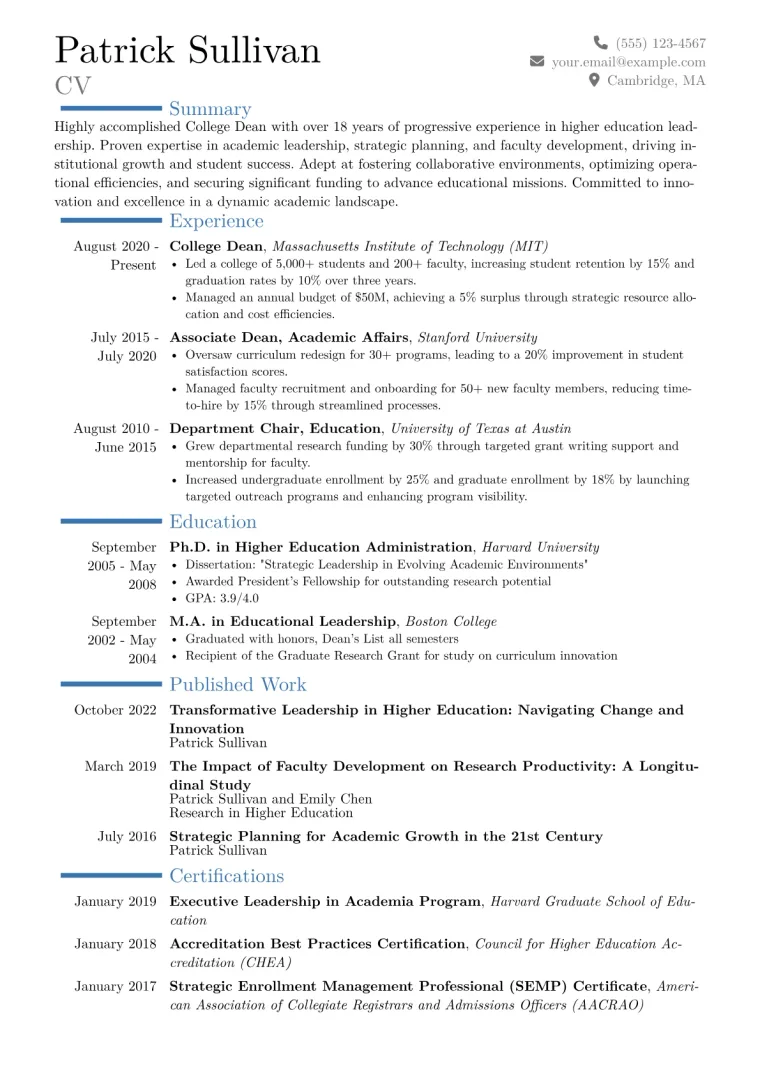
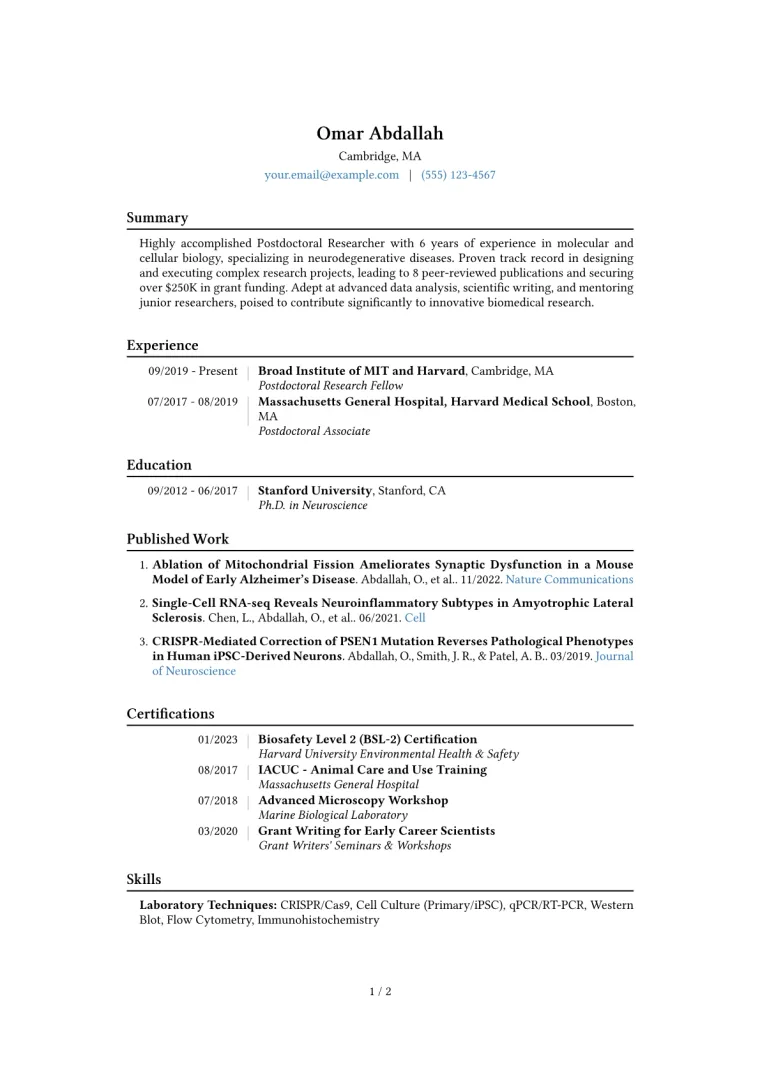
Send an academic CV for: doctoral and postdoctoral positions, fellowships, lectureships, research-institute posts, grant applications, and academic-adjacent roles at scholarly publishers, learned societies, and funders.
Send a resume for: industry research and data roles, engineering, consulting, policy jobs outside academia, startups, and anything advertised through a corporate careers portal.
When the advert says "CV" but the employer is a company, they usually mean a resume: two pages, tailored, no publication list. Country matters here too, since "CV" is the everyday word for a resume across the UK and most of Europe. If the document is going to a corporate recruiter, write a resume whatever the advert calls it.
When you genuinely cannot tell, look at who reads it first. A panel of academics wants completeness. A recruiter screening fifty applications wants one page that maps to the job description.
The two documents are not long and short versions of each other. They are built on opposite principles.
| Academic CV | Resume | |
|---|---|---|
| Purpose | Document the full record | Argue for one specific job |
| Length | As long as the record: 4 to 10+ pages | 1 to 2 pages |
| Publications | Listed in full, numbered | Omitted, or one line: "4 peer-reviewed publications" |
| Teaching | Its own section with student numbers | One line if relevant to the role |
| Funding | Its own section with amounts | Only if it demonstrates the job's skills |
| Methods | Comprehensive technical section | Only what the advert asks for |
| Tailoring | Reordered per application | Rewritten per application |
| Judged on | Evidence produced | Fit with the specification |
The consequence people miss: a resume is not a subset of your CV. Cutting a ten-page CV down to two pages produces a bad resume, because the surviving lines are still written to document rather than to persuade.
This is the harder direction, and most of it is translation work.
Translate the thesis into a project. A panel wants the title and the supervisor. A hiring manager wants to know what problem you solved, with what, and what came out. "Built a real-time prediction pipeline over five years of transit data, cutting inference latency from 40 minutes to 9" reads as engineering. "Investigating spatiotemporal prediction in urban transport networks" reads as a thesis title, because it is one.
Convert publications into evidence of skills. A resume does not carry a publication list. It carries the capabilities the publications prove: experimental design, statistical modelling, writing for review, collaborating across institutions. One summary line for the papers is fine.
Reframe teaching as communication and leadership. Convening a seminar for thirty students is stakeholder communication. Supervising a master's student is mentoring. Both matter to a hiring manager who will never read your teaching statement.
Name the tools explicitly. Academic CVs get away with "computational methods". A resume needs Python, PyTorch, SQL, whatever the advert lists, because that is what a recruiter and their filters search for.
What to cut: the full publication list, conference attendance, module codes, your supervisor's name, thesis chapter structure, and any section that exists only for completeness.
Easier, with two traps.
Restore the record. Every paper, every talk you gave, every award, every module. Completeness is the point, and omitting a paper because it is middle-author looks like an incomplete list rather than editorial judgement.
Then stop persuading. Academic CVs do not carry summaries of your strengths or bullet points about impact on business outcomes. Facts, dated, in order. The persuasion goes in the cover letter and research statement.
Section order for the academic version, along with how it shifts between doctoral applications, postdoctoral posts, and lectureships, is covered in academic CV for PhD applications and, for research-only posts, the UK research CV.
This is the conversion that matters, so here it is in full. One person, one doctorate, two documents.
On the academic CV:
Education PhD Computer Science, University of Manchester, 2021 to 2025 Thesis: "Spatiotemporal prediction under sparse observation in urban transit networks". Supervisor: Prof. R. Hastings.
Publications
- Patel, A., Hastings, R. (2025). Sequential prediction under sparse sensing. Transportation Research Part C, 158.
- Patel, A., Adeyemi, K., Hastings, R. (2024). A lightweight pipeline for real-time arrival estimation. ITSC Proceedings.
Teaching Graduate teaching assistant, Algorithms and Data Structures, 2022 to 2024. Two cohorts, approximately 180 students.
On the resume, same person:
Machine Learning Engineer (PhD), University of Manchester 2021 to 2025 Built a real-time arrival prediction service over sparse sensor data, deployed for a city transit operator and serving around 1,200 riders weekly at 99.7% uptime. Cut model inference from 40 minutes to 9 by rewriting the feature pipeline and batching writes. Published two peer-reviewed papers on the method; presented to an industry audience of 200. Taught algorithms to 180 undergraduates across two years, including designing assessment material.
Nothing was invented between those two versions. The thesis became a deployed system with users and uptime, the papers became one line of credibility instead of a numbered list, and teaching became instruction at scale. Same facts, doing a different job.
Most of the conversion is vocabulary. A rough map:
| Academic activity | What it is on a resume |
|---|---|
| Thesis | A multi-year technical project with a deliverable |
| Literature review | Domain research and requirements analysis |
| Conference presentation | Presenting technical work to an external audience |
| Peer review | Technical review and quality assurance |
| Supervising a master's student | Mentoring a junior colleague |
| Grant application | Writing a funded proposal, with the amount |
| Teaching a module | Training delivery, with headcount |
| Lab rotation or collaboration | Cross-functional project work |
| Managing a shared instrument or cluster | Owning shared infrastructure |
One warning before you use that. Do not inflate: "led a cross-functional team" for a two-person collaboration will not survive an interview. And keep one honest thing that only a researcher can claim, usually the depth: five years on one hard problem is a differentiator, not something to hide.
An academic CV is read by people in your field who can evaluate a venue and an author position on sight. Nothing needs translating, and abbreviating your record insults their ability to read it.
An industry resume is read first by a recruiter who is not a specialist, and often by a parser before that. That matters twice over. The words from the advert need to appear literally, because literal is what gets searched. And the layout has to survive machine reading, which rules out the multi-column templates that look sophisticated and parse as gibberish.
That second point is worth testing rather than assuming, especially with a document that started life as an academic CV. The free ATS checker shows what a parser actually extracts from your file, without an account.
The reason people end up with five stale versions of both documents is that they maintain each one by hand.
The fix is to hold the record once and let the output change. JobSprout stores your content separately from the design, so the same profile prints as a multi-page academic CV with a numbered publication list, or as a one-page resume in a commercial template, without retyping anything. Publication entries fill themselves in from a DOI, PubMed, or arXiv link, which is the part that otherwise decays fastest. The academic CV builder shows the academic side of that at doctoral, postdoc, and lecturer stage.
For the industry direction, run the resume through a parser before you send it. The free ATS checker reports what a screening system actually extracts, which is worth knowing when your document was originally written for human panels.
Advice to keep a resume to one page is aimed at graduates. A doctorate plus a postdoc is genuinely two pages of relevant experience, and compressing it costs you evidence for no gain.
Use one page if you are applying straight out of the PhD with no industry experience and no long research record. Use two once you have a postdoc, an internship, or a publication record worth summarising. Beyond two pages you are writing a CV again, whatever you call the file.
The related trap is cramming two pages of content into one by dropping to 9pt type and quarter-inch margins. That reads as a person who could not edit, which is worse than a second page.
The checks that catch most of what goes wrong.
The file name says who you are: Anjali-Patel-CV.pdf, not cv_final_v3.pdf. It sits in a recruiter's download folder next to two hundred others.
The document is a PDF unless the portal demands otherwise, and it is a PDF with real text rather than a scan or an exported image.
The words from the advert appear in the document, literally, if they are true of you. Paraphrase is invisible to a keyword search.
Dates are formatted one way throughout. Mixing "Sept 2024" and "09/2024" in the same document is a small thing that reads as carelessness on a document partly assessed on precision.
Someone outside your field has read it. A friend who cannot evaluate your venues will tell you which lines are incomprehensible. On an industry resume that is the feedback that matters most.
Industry research labs. DeepMind, Microsoft Research, pharmaceutical research divisions: these sit between the two worlds and often accept either. Send a resume unless the advert asks for a CV, but keep the publication list as a one-line summary with a link, because there the papers genuinely are the evidence.
Teaching-focused posts at colleges. Academic CV, but with teaching moved above research, and any evidence of pedagogical training foregrounded.
Science policy and funding bodies. Usually a resume, occasionally a two-page narrative CV. Read the call: these organisations tend to specify.
Applications outside the UK and US. Continental European employers may expect a photo and date of birth, and EU institutions frequently require the standard EU format. See the Europass CV format. For the general difference in what the words mean by country, CV vs resume covers it.
You can, and it usually reads as a misunderstanding of the role. A hiring manager receiving eight pages with a numbered publication list for a data science post concludes that you are applying to academia and using them as a fallback.
Not as a list. One line summarising the count, with a link to Google Scholar or your site, gives a curious reader the route without spending half a page.
Yes, always, under education with the thesis reframed as a project. The doctorate is a strong signal; the thesis title is not.
Only when a call sets that limit, which some fellowship schemes do. Otherwise a two-page academic CV reads as an incomplete record.
Give dates without apology. Doctorates take the time they take, and hiring managers who work with researchers know it. Do not invent a narrative for a normal timeline.