PDF or DOCX · up to 2MB
Learn how to write a resume for an internal transfer. Includes a full example, summary templates for lateral moves, promotions and department changes, weak vs strong comparisons, and advice on navigating the politics.
Write a prompt engineer resume that gets interviews. Full resume example, summary templates, 10+ experience bullets, technical skills breakdown, and tips for career changers from software engineering, copywriting, data science, and UX research.
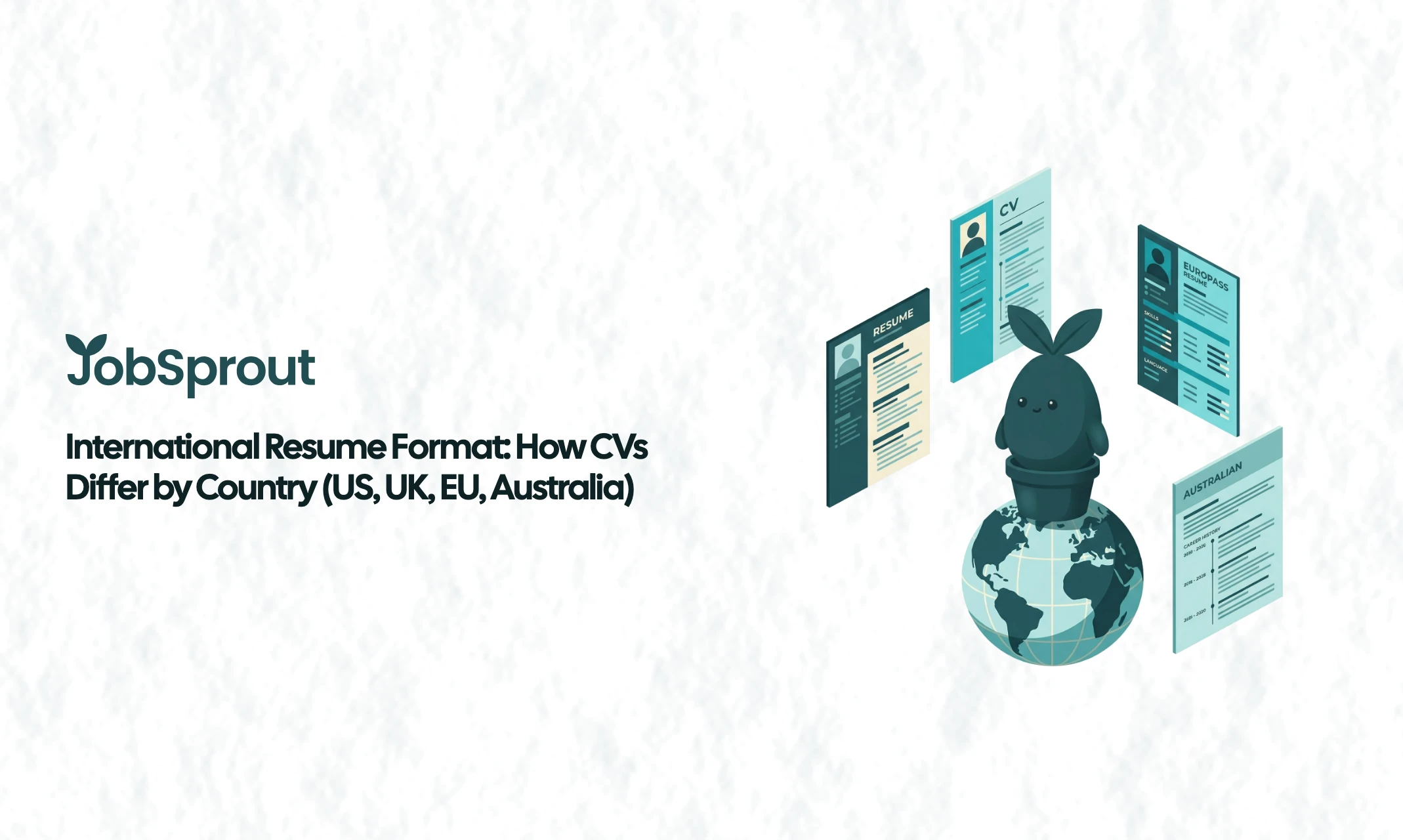
Learn how resume and CV formats differ across countries. Covers the US, UK, Germany, France, Australia, Japan, and the Middle East with comparison tables and practical tips.

Declining a job offer is awkward, but doing it well is a career skill. Use these 7 email templates to say no gracefully, preserve the relationship, and keep the door open for future opportunities.
Most people assume that applying for an internal transfer is a casual process. You already work at the company. Your manager knows you. HR has your file. Surely you just update your title on the old resume, send it through the internal portal, and wait for the conversation to happen naturally.
This assumption has torpedoed more internal applications than any formatting mistake or missing keyword ever could.
The reality is that internal transfers are formal hiring processes at most mid-size and large organisations. The recruiter or HR business partner handling the new role needs a resume in the system. The hiring manager for the target department may not know your work at all, or may know you only from a handful of cross-functional meetings. And the resume you submitted when you first joined the company is almost certainly outdated, missing two or three years of growth, new responsibilities, and measurable results.
According to LinkedIn's Workplace Learning Report, employees who make internal moves have a significantly higher chance of staying at the company long-term compared to those who remain in the same role. Companies genuinely want internal mobility to work. But wanting it to work and handing you the role without a strong application are two very different things.
This guide covers everything you need to write a resume that makes the case for your internal transfer: how it differs from an external resume, what to emphasise, a full example, summary templates, and advice on the politics.
If you are also writing a cover letter for this application, read our guide on cover letters for internal positions alongside this one. The two documents work together, but they serve different purposes.
The core purpose of a resume does not change: you are making a case that your skills and experience qualify you for a specific role. But the context of an internal application shifts several things about how you write it.
Even if the hiring manager has already told you informally that they would love to have you on their team, the application still needs to go through the system. Most organisations require a resume submission through their internal careers portal. The HR business partner reviewing applications may be screening dozens of internal and external candidates simultaneously. Your resume needs to stand on its own in that pile.
This is the mistake that catches most internal applicants off guard. You assume that because you work at the same company, the hiring manager is familiar with your contributions. In practice, a marketing director hiring for a strategist role may have no idea what the operations analyst on the third floor has accomplished over the past three years. Different departments operate in different worlds, even within the same building.
Your resume needs to do the same job it would for an external application: clearly communicate who you are, what you have done, and why it matters for this specific role.
The resume you used to get hired is a snapshot of who you were before you joined the company. It does not include the projects you have led, the systems you have learned, the relationships you have built, or the promotions you have earned since then. Submitting it with a quick title update signals that you are not taking the process seriously.
An external resume focuses on proving you can do the job and fit the culture. An internal resume shifts the emphasis toward proving you are ready for more. The culture fit is already established. What the hiring manager wants to know is whether you can translate your current experience into value for their team.
| External Resume Focus | Internal Resume Focus |
|---|---|
| Proving cultural fit | Demonstrating readiness to grow |
| Company research and alignment | Insider knowledge and cross-functional impact |
| Transferable skills from other companies | Company-specific achievements and systems knowledge |
| Why you want to leave your current job | Why you want to contribute at a deeper level within this company |
Knowing what to highlight is more than half the battle. Internal resumes succeed or fail based on whether you can reframe your current work in terms that matter to the target department.
Any time your work has touched another team, that is gold for an internal transfer resume. Cross-functional projects prove that you can operate outside your current silo, collaborate with different stakeholders, and deliver results in unfamiliar territory.
Think about:
This is your unfair advantage over every external candidate. You know the internal systems, the company culture, the decision-making processes, the tools, and the people. Make this visible on your resume.
If you have expertise in internal platforms (Salesforce configurations specific to your company, proprietary tools, internal reporting dashboards), mention them. If you understand the regulatory environment your company operates in, say so. If you know the customer base from direct interaction, that matters.
External candidates have to learn all of this from scratch. You already know it. That saves the hiring manager months of onboarding time, and you should make that saving explicit.
Many professionals leave their most impressive internal contributions off their resume because those contributions do not fit neatly under their job title. Do not make this mistake.
If you have:
These experiences demonstrate leadership, initiative, and engagement with the broader organisation. They matter enormously for internal transfers because they show you care about the company beyond your immediate responsibilities.
This is the most strategic element. Before you write a single bullet point, study the job description for the target role and ask yourself: which of my current results would matter most to this team?
If you are moving from operations to project management, your process improvement metrics matter more than your day-to-day operational tasks. If you are transferring from customer support to product, your insights about user pain points matter more than your ticket resolution times.
Every bullet point should pass the test: would the hiring manager for the new role care about this?
Below is a complete resume for a marketing coordinator transferring to a product management role within the same company. Notice how the current role is framed in terms that a product hiring manager would value.
SARAH CHEN
London, UK | sarah.chen@email.com | linkedin.com/in/sarahchen

PROFESSIONAL SUMMARY
Marketing Coordinator with 3 years at Nexus Technologies, seeking to
transition into product management. Led the Voice of Customer programme
that directly informed 4 product feature launches. Deep expertise in
Nexus's B2B customer base, internal analytics stack (Mixpanel, Looker,
Salesforce), and cross-functional collaboration between marketing,
product, and engineering teams.

EXPERIENCE

Marketing Coordinator | Nexus Technologies
June 2023 - Present

- Created and managed the Voice of Customer programme, conducting 60+
  user interviews that informed the product roadmap for Q1-Q3 2026
- Analysed product usage data in Mixpanel to identify 3 underperforming
  features, presenting findings to the product team and contributing to
  a 22% improvement in feature adoption after redesign
- Collaborated with the product and engineering teams on 4 feature
  launches, writing positioning documents, coordinating beta testing
  with 150 customers, and developing go-to-market strategies
- Built a customer feedback taxonomy used by both marketing and product
  teams, reducing duplicate feature requests by 35%
- Served on the cross-functional Customer Experience Committee, working
  alongside product managers, engineers, and support leads to improve
  NPS from 42 to 58 over 18 months
- Mentored 2 junior marketing associates on data analysis and
  customer research methodologies

Marketing Assistant | Nexus Technologies
January 2022 - May 2023

- Supported product launch campaigns for 6 major releases, gaining
  direct exposure to the product development lifecycle
- Managed the company blog and contributed 40+ articles, including
  product-focused content that required close collaboration with
  engineering
- Conducted competitive analysis for 3 product categories, producing
  reports used by both marketing and product leadership

Digital Marketing Intern | Bright Agency
June 2021 - December 2021

- Assisted with client campaign management and reporting
- Gained foundational experience in analytics, A/B testing, and
  user behaviour analysis

EDUCATION

BSc Marketing | University of Leeds
September 2018 - June 2021

ADDITIONAL

- Completed Nexus internal Product Management Foundations programme
  (2025)
- Google Analytics Certified (2023)
- Active member of Nexus Women in Tech network since 2022
A few things to notice about this example:
The summary immediately addresses the transition. It does not hide the fact that Sarah is a marketing coordinator. Instead, it bridges the gap by highlighting product-relevant work and company-specific knowledge.
The bullet points are reframed for the target audience. Rather than listing marketing tasks, each bullet emphasises the product impact: user interviews that informed the roadmap, data analysis that improved feature adoption, cross-functional work with product and engineering.
Internal contributions are prominently featured. The Customer Experience Committee, the mentoring, and the internal training programme all appear because they demonstrate skills the product role requires.
External experience is present but brief. The internship at Bright Agency gets two bullet points. It is relevant but not the focus.
For guidance on formatting promotions within the same company (like Sarah's move from Marketing Assistant to Marketing Coordinator), see our guide on how to show promotions on a resume.
Your professional summary is the first thing the hiring manager reads, and for internal transfers it does the heaviest lifting. It needs to acknowledge where you are, signal where you want to go, and bridge the gap in three to four sentences.
Here are three templates for the most common scenarios.
Operations Analyst with 4 years at Meridian Financial, seeking a lateral move into the Risk Analytics team. Built automated reporting pipelines now used by 3 departments including Risk, and collaborated directly with the Risk team on the Q2 2025 stress testing project. Strong proficiency in Meridian's internal data infrastructure (Snowflake, Tableau, proprietary risk models) and a track record of translating complex data into actionable insights for non-technical stakeholders.
Why it works: It acknowledges the lateral nature of the move, highlights direct collaboration with the target team, and emphasises company-specific technical knowledge that would take an external hire months to learn.
Customer Success Manager with 5 years at CloudBridge, applying for the Head of Customer Success position. Grew the Enterprise segment book of business from 12 to 34 accounts while maintaining a 94% retention rate. Led the onboarding process redesign that reduced time-to-value by 40% and has been adopted company-wide. Ready to bring this same operational rigour and customer-first mindset to leading the full CS team.
Why it works: The summary leads with scope and impact rather than daily responsibilities. It demonstrates that the candidate has already been operating at a higher level, which is exactly what the hiring manager for a promotion needs to see.
For more examples of professional summaries across different scenarios, see our resume summary examples.
Finance Analyst with 3 years at Atlas Retail, seeking to transition into People Operations. Designed the finance team's workforce planning model, collaborating closely with HR on headcount forecasting, compensation benchmarking, and budget allocation for the annual hiring plan. Completed Atlas's internal HR Foundations programme and volunteered as a mentor in the graduate onboarding programme for the past 2 years.
Why it works: Department changes require the strongest bridge between current and target roles. This summary does not try to hide the finance background. Instead, it draws a direct line between finance work and HR-adjacent responsibilities, supported by internal training and volunteering that demonstrate genuine commitment to the new field.
This is where most internal transfer resumes fall apart. Candidates describe their current role the same way they would on a standard resume, using the language and priorities of their current department. But the hiring manager in the target department thinks in different terms.
The fix is to translate your bullet points into the target department's language. Same achievement, different framing.
Weak: Managed daily warehouse operations, ensuring orders were processed within SLA targets.
Strong: Coordinated cross-functional workflows across warehouse, logistics, and customer service teams, delivering 98% on-time order fulfilment through proactive bottleneck identification and stakeholder communication.
Weak: Created email campaigns that achieved a 24% open rate and 3.2% click-through rate.
Strong: Designed and ran 15 product-focused A/B experiments across email and in-app channels, generating behavioural data that informed 3 feature prioritisation decisions on the product roadmap.
Weak: Resolved an average of 45 customer tickets per day with a 96% satisfaction rating.
Strong: Identified upsell opportunities through customer conversations, flagging 120+ qualified expansion leads to the sales team over 12 months, contributing to a 15% increase in account expansion revenue.
Weak: Prepared monthly financial reports and variance analysis for the CFO.
Strong: Built the workforce planning and compensation benchmarking models used by HR and Finance jointly, providing data-driven recommendations that shaped the annual hiring plan for 3 consecutive years.
Weak: Developed and maintained backend microservices using Python and PostgreSQL.
Strong: Authored internal technical documentation for 8 microservices, reducing onboarding time for new engineers by 30% and establishing documentation standards adopted across the engineering department.
The pattern is consistent: identify the skill or result that matters to the new department, and lead with that. The underlying work is the same. The framing is different.
If you want to take this further, JobSprout can help you tailor your resume to a specific job description, rewriting bullet points to match the language and priorities of the target role.
Yes, but with a clear hierarchy.
Your internal experience should take up the majority of the resume. It is the most relevant, the most recent, and the most verifiable. The hiring manager can check your claims with a quick conversation with your current colleagues. That makes internal achievements the most credible items on your resume.
External experience still matters, especially if it fills a gap. If the target role requires skills you developed at a previous company but have not yet used in your current position, include those. If your external experience is in the same field as the target department, it strengthens the case that your interest is genuine and long-standing.
Here is a rough guideline for how to weight your content:
| Experience Type | Space on Resume | Detail Level |
|---|---|---|
| Current role at the company | 50-60% | Full detail, heavily tailored to target role |
| Previous roles at the company | 15-20% | Moderate detail, focusing on progression |
| External experience in a related field | 10-15% | Concise, highlighting transferable skills |
| External experience in an unrelated field | 5-10% | Brief, focusing on broadly relevant achievements |
The key principle: the closer the experience is to your current company and the target role, the more space it earns.
The resume is only one part of an internal transfer. The politics around it can be just as important, and far more uncomfortable.
This is the question that causes the most anxiety, and there is no universal answer. It depends entirely on your relationship with your manager and the culture of your organisation.
Tell them first if:
Consider waiting if:
If you do tell them, frame it as a positive. "I have grown a lot in this role and I am excited about the opportunity to contribute to the company in a new way" is far better than "I am bored and need a change." Most good managers will appreciate the transparency and may even advocate for you.
Avoid applying for internal transfers during:
The best timing is usually after a strong performance review or the successful completion of a significant project. You have fresh evidence of your impact, and your current team is in a stable position.
The strongest internal transfers do not begin with a resume submission. They begin months earlier with relationship building. If you know you want to move into a specific department, start building connections there well before any role opens.
Volunteer for cross-functional projects with that team. Attend their team meetings if they are open. Have informal coffee conversations with people in the department to understand their challenges and priorities. When a role does open, you will not be a stranger submitting a cold application. You will be someone they already know and want on their team.
Your resume from two or three years ago does not reflect who you are today. It was written for a different role, possibly at a different company. Every internal transfer requires a freshly written resume that reflects your current skills, achievements, and growth.
Even if you have met them in meetings, they do not know the details of your daily contributions. Your resume needs to spell everything out as clearly as it would for an external application. Do not leave anything to assumption.
Every department has its own acronyms and terminology. If you are moving from engineering to marketing, do not assume the marketing director knows what "reduced P99 latency by 40ms" means. Translate technical achievements into business impact: "Improved application response time, contributing to a 12% increase in user session duration."
This is the single most common mistake. Candidates list their current responsibilities as they would describe them to their own manager, without reframing them for the target department. Every bullet point should be written with one question in mind: does the hiring manager for the new role care about this?
Committee work, mentoring, training programme participation, and cross-functional volunteering are not "extras" on an internal transfer resume. They are evidence that you operate beyond your job description, care about the organisation broadly, and are ready for a bigger role. Include them prominently.
The professional summary is where you explicitly state your intention and bridge the gap between your current role and the target role. Leaving it generic ("Results-driven professional with X years of experience") wastes the most valuable real estate on your resume.
An internal transfer resume and cover letter work as a pair. The resume shows what you have done. The cover letter explains why you want to make this move and what you would bring to the new team. Submitting one without the other weakens your application. Our guide on cover letters for internal positions covers this in detail.
Writing a resume for an internal transfer is not harder than writing one for an external application. It is different. The emphasis shifts from proving you can fit the culture to proving you are ready for more. The evidence shifts from transferable skills at other companies to specific achievements within this one. And the politics, while uncomfortable, are navigable with the right approach.
Start by studying the job description for the target role and identifying which of your current achievements would matter most to that hiring manager. Reframe your bullet points in their language, not yours. Lead with cross-departmental impact, company-specific knowledge, and results that benefit the target team. Write a summary that explicitly bridges the gap between where you are and where you want to go.
If you want to speed up the tailoring process, JobSprout can analyse a job description and rewrite your resume bullet points to match the target role's priorities, which is especially useful when you are translating your experience from one department's language into another's.
Then have the conversation with your manager if you can, build relationships with the target team if you have not already, and submit a resume that makes it easy for the hiring manager to say yes.
Internal mobility is one of the strongest career moves you can make. You already have the institutional knowledge, the relationships, and the track record. Your resume just needs to make that visible to the people who have not been watching.