PDF or DOCX · up to 2MB
Most people never negotiate their salary and leave thousands on the table. Use these 5 proven email templates to counter offer, ask for a raise, or negotiate benefits with confidence.

Write a prompt engineer resume that gets interviews. Full resume example, summary templates, 10+ experience bullets, technical skills breakdown, and tips for career changers from software engineering, copywriting, data science, and UX research.
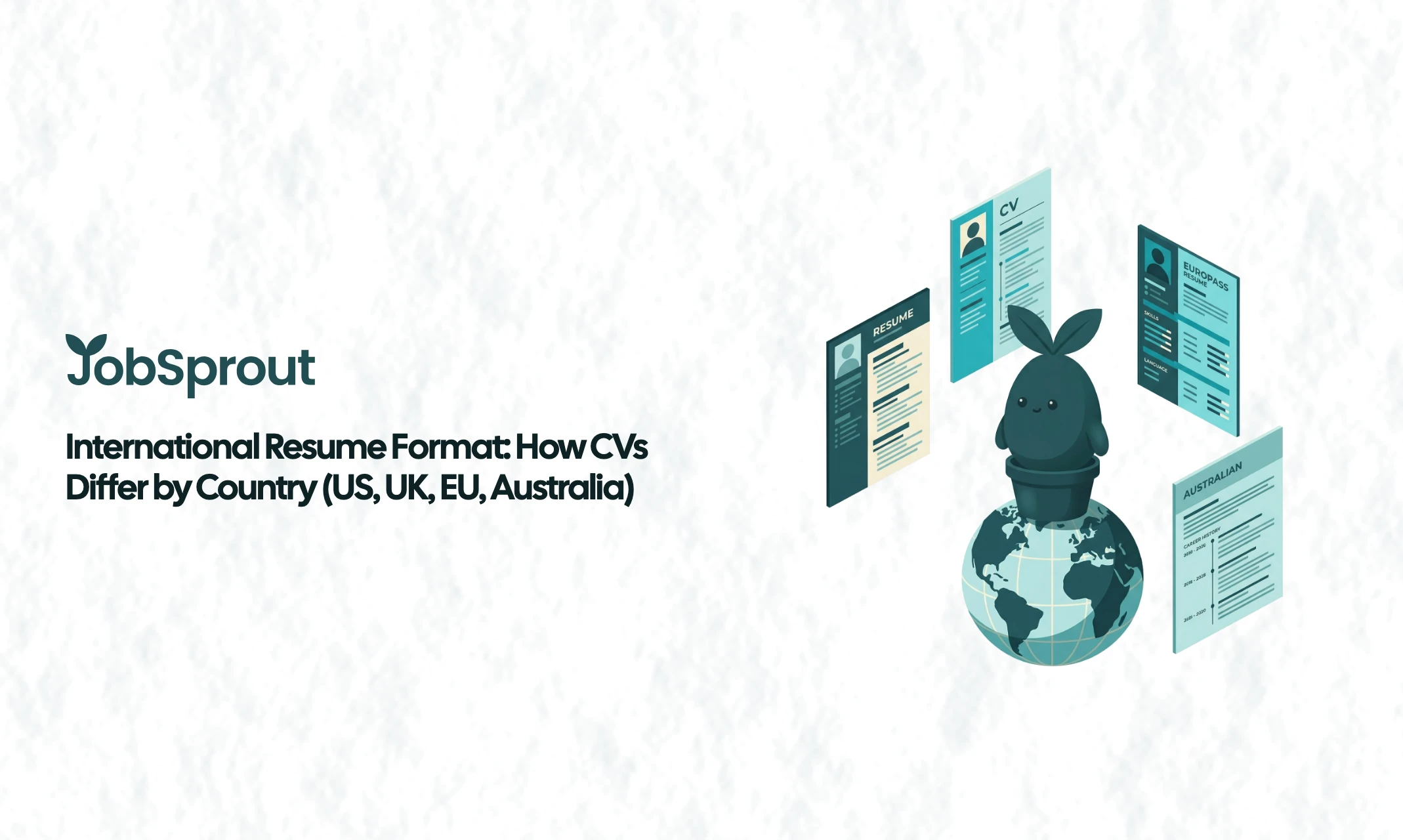
Learn how resume and CV formats differ across countries. Covers the US, UK, Germany, France, Australia, Japan, and the Middle East with comparison tables and practical tips.
Learn how to write a resume for an internal transfer. Includes a full example, summary templates for lateral moves, promotions and department changes, weak vs strong comparisons, and advice on navigating the politics.
Most workers have never negotiated their salary. Not once. According to Pew Research Center, only 32% of men and 28% of women negotiate their starting salary. That single decision to stay silent costs the average worker more than £500,000 over the course of a 40-year career, once you account for compounding raises, bonuses, and pension contributions that are all pegged to a lower baseline.
The data on what happens when people do negotiate is even more striking. Research from the Harvard Business Review and multiple compensation studies consistently shows that candidates who negotiate their initial offer receive a 7-10% increase on average. On a £45,000 salary, that is an extra £3,150 to £4,500 in year one alone. Over a decade, factoring in annual raises calculated as a percentage of base pay, that single conversation is worth tens of thousands of pounds.
So why don't people negotiate? The most common reasons are fear of the offer being rescinded (this almost never happens), not knowing what to say, or feeling uncomfortable having the conversation out loud. That last barrier is exactly why email negotiation is so powerful, and it is the focus of this entire guide.
Not every negotiation needs to happen over the phone. In many cases, email is the better medium. Here is when each approach makes sense.
For most people in most situations, email is the safer and more effective starting point. You can always escalate to a phone call after the initial exchange.
Every successful salary negotiation email follows the same four-part structure. Think of it as a formula you can apply to any situation.
Open by thanking the employer for the offer. This sets a positive tone and signals that you are approaching the conversation collaboratively, not adversarially. Keep it to one or two sentences.
Express genuine excitement about the role, the team, or the company. This reassures the employer that you want to accept. Negotiation should never feel like a threat to walk away (even if you have other options). It should feel like two people trying to find an agreement that works.
State your desired number or benefit clearly and specifically. Vague language ("I was hoping for something a bit higher") is weak. A specific number ("Based on my research, I believe £55,000 more accurately reflects the market rate for this role") is strong.
Back up your counter with evidence. This can include market data (Glassdoor, LinkedIn Salary Insights, Levels.fyi), your specific experience, relevant certifications, competing offers, or the unique value you bring. The justification is what transforms your counter from a request into a reasonable, data-backed proposition.
The formula in practice: Gratitude + Enthusiasm + Counter + Justification = Professional, effective negotiation.
Below are five templates covering the most common negotiation scenarios. Each one follows the formula above. Adapt the specifics to your situation, but keep the structure intact.
This is the most common scenario. You have received a written offer and the salary is below your target.
Subject: Re: Offer for Senior Marketing Manager - [Your Name]
Dear [Hiring Manager's Name],
Thank you so much for the offer for the Senior Marketing Manager role at [Company]. I truly enjoyed the interview process and was particularly impressed by the team's approach to data-driven campaign strategy. I am excited about the opportunity to contribute to [specific project or goal discussed in interviews].
After careful consideration, I would like to discuss the base salary. The offer of £48,000 is below the market range I have found through my research. According to Glassdoor and LinkedIn Salary Insights, the median salary for a Senior Marketing Manager in [City] with [X] years of experience is between £52,000 and £58,000.
Given my [specific experience, e.g., "five years leading B2B campaigns with a track record of 30% year-on-year growth in qualified leads"], I believe a base salary of £55,000 would more accurately reflect both the market rate and the value I would bring to the team.
I am very keen to join [Company] and am confident we can find an arrangement that works for both of us. I am happy to discuss this further at your convenience.
Kind regards, [Your Name]
Why it works: It opens with genuine gratitude and specific enthusiasm (proving this is not a generic template). The counter is a precise number backed by named data sources. The closing reaffirms interest and invites collaboration.
Sometimes an offer comes in significantly below market rate. This template handles that situation firmly but respectfully.
Subject: Re: Offer for Software Engineer - [Your Name]
Dear [Hiring Manager's Name],
Thank you for extending the offer for the Software Engineer position at [Company]. I appreciate the time the team invested in the interview process, and the technical challenges discussed during my system design round genuinely excited me.
I want to be transparent: the offered salary of £38,000 is considerably below the market range for this role. My research across Glassdoor, Levels.fyi, and PayScale indicates that the median for a mid-level Software Engineer in [City] is between £48,000 and £55,000. I have also received an offer from another company at £50,000, which I am sharing in the spirit of transparency rather than as leverage.
I would love to join [Company]. The engineering culture and the product roadmap align closely with where I want to take my career. To make this work, I would need a base salary of at least £50,000, which sits at the lower end of the market range.
I am happy to discuss this further and am flexible on other elements of the package if that helps. Please let me know your thoughts.
Kind regards, [Your Name]
Why it works: It acknowledges the gap directly without being confrontational. Mentioning a competing offer provides external validation for the counter. The phrase "in the spirit of transparency" frames the competing offer as honesty, not a threat. Offering flexibility on other elements shows willingness to compromise.
Negotiating a raise is different from negotiating a new offer. You need to justify the increase based on the value you have already delivered.
Subject: Discussion about my compensation
Dear [Manager's Name],
I wanted to schedule a time to discuss my compensation. Over the past [time period], I have taken on several responsibilities beyond my original role, and I believe my current salary no longer reflects my contribution to the team.
Here are a few highlights from the past year:
- Led the [project name] initiative, which resulted in [specific measurable outcome, e.g., "a 22% reduction in customer churn"]
- Took ownership of [additional responsibility] after [colleague's name] departed, managing it alongside my existing workload
- Mentored two junior team members, both of whom have since been promoted
- Consistently exceeded quarterly targets by an average of [X]%
Based on my research, the market rate for a [Your Title] with my experience in [City] is between £[X] and £[Y]. My current salary of £[current salary] falls below this range. I would like to discuss an adjustment to £[target salary], which reflects both the market rate and the expanded scope of my role.
I genuinely enjoy working here and am committed to the team's goals for the coming year. I would appreciate the opportunity to discuss this at a time that suits you.
Kind regards, [Your Name]
Why it works: It leads with concrete achievements, not feelings. Bullet points make the value proposition scannable. The market data provides external justification, while the closing reinforces loyalty and long-term commitment.
Some companies have rigid salary bands, particularly in the public sector or at larger organisations. When the number cannot move, you negotiate everything around it.
Subject: Re: Offer for Programme Analyst - [Your Name]
Dear [Hiring Manager's Name],
Thank you for the offer for the Programme Analyst role. I am genuinely excited about the opportunity to work with the [department/team] and contribute to [specific initiative].
I understand that the salary of £42,000 is set within the band for this grade, and I respect the structure. I would like to explore whether there is flexibility in other areas of the package to bring the total compensation closer to what I had in mind. Specifically, I would like to discuss:
- Remote working: Would the team support a hybrid arrangement of three days in-office, two days remote?
- Annual leave: Is there scope to increase the holiday allowance from 25 to 28 days?
- Professional development: I am pursuing my [certification/qualification]. Would the company be willing to cover the £1,500 course fee?
- Signing bonus: Given the salary is fixed, would a one-off signing bonus of £2,000 be possible to bridge the gap?
I want to make this work and am very keen to accept. These adjustments would make a real difference and I am happy to be flexible on the specifics.
Kind regards, [Your Name]
Why it works: It acknowledges the salary constraint upfront, which shows you are listening and reasonable. Presenting multiple options gives the employer room to say yes to some, even if they cannot say yes to all. The closing avoids ultimatums and keeps the door open for creative solutions.
Sometimes the gap between the offer and your minimum is too large. This template lets you decline gracefully while preserving the relationship for future opportunities.
Subject: Re: Offer for Account Director - [Your Name]
Dear [Hiring Manager's Name],
Thank you again for the offer for the Account Director position at [Company]. I have thoroughly enjoyed getting to know the team throughout the interview process, and I have a great deal of respect for the work [Company] is doing in [specific area].
After careful consideration, I have decided not to accept the offer at this time. The compensation package, while generous, does not align with my current financial requirements and career trajectory. This was not an easy decision, as the role itself is exactly the kind of challenge I am looking for.
I would very much like to stay in touch. If the budget for this role changes in the future, or if a more senior position opens up, I would welcome the opportunity to revisit the conversation. I will continue to follow [Company]'s progress with interest.
I wish you and the team all the best in finding the right person for this role.
Kind regards, [Your Name]
Why it works: It is warm, professional, and specific about why you are declining. It avoids burning bridges by explicitly inviting future contact. Many candidates who decline gracefully are contacted again when budgets change or new roles open up.
The subject line of a negotiation email matters more than most people think. It sets the tone before the recipient reads a single word of your message.
| Scenario | Subject Line | Why It Works |
|---|---|---|
| Counter offer (reply) | Re: Offer for [Role Title] - [Your Name] | Keeps the email in the existing thread. Clean and professional. |
| Counter offer (new thread) | [Role Title] Offer - Compensation Discussion | Direct and clear. No ambiguity about the purpose. |
| Raise request | Discussion about my compensation | Neutral and non-threatening. Does not put the manager on the defensive. |
| Benefits negotiation | Re: Offer for [Role Title] - Package Discussion | Signals you want to discuss the broader package, not just reject the salary. |
| Follow-up after no response | Following Up - [Role Title] Compensation Discussion | Polite and specific. Avoids the word "urgent." |
| Declining an offer | Re: Offer for [Role Title] - [Your Name] | Keeps it in the original thread. The content speaks for itself. |
General rules for subject lines:
A negotiation without data is just a guess. Before you write a single word of your email, spend 30 minutes researching what your role actually pays in your market. Here are the best resources.
The most widely used salary research tool. Search by job title, company, and location to see reported salary ranges. Filter by experience level. The data is self-reported, so treat it as a range rather than a definitive answer.
Best for: General market ranges across all industries.
Available to LinkedIn Premium subscribers. Shows salary distributions for specific titles in specific locations, broken down by experience, industry, and company size. The data quality is strong because it pulls from LinkedIn's massive professional network.
Best for: Comparing across company sizes and industries.
Originally focused on technology companies, Levels.fyi now covers a broader range of industries. It excels at showing total compensation (base + bonus + equity) rather than just base salary. This is critical for roles where bonus or equity make up a significant portion of pay.
Best for: Technology roles and total compensation breakdowns.
PayScale lets you build a personalised salary report based on your specific experience, skills, certifications, and location. It accounts for more variables than most tools, giving you a more tailored estimate.
Best for: Personalised estimates that account for your unique profile.
Do not anchor on a single source. Pull data from at least two or three platforms and look for the overlapping range. If Glassdoor says £48,000-£56,000 and LinkedIn says £50,000-£58,000, the sweet spot is likely £50,000-£56,000. Your target should sit in the upper half of the overlap, giving you room to negotiate down while still landing within your acceptable range.
When you reference market data in your negotiation email, name your sources. "According to Glassdoor and LinkedIn Salary Insights" carries far more weight than "based on my research." Specificity builds credibility.
If you are building your CV alongside your negotiation research, tools like JobSprout can help you articulate your experience and achievements in a way that supports your case. A well-written CV with quantified accomplishments doubles as your negotiation evidence file.
Base salary is only one part of your total compensation. When the salary is fixed or you have already pushed as far as it will go, these are the levers you should be pulling.
| Benefit | Typical Negotiability | How to Ask |
|---|---|---|
| Signing bonus | High | "Would a one-off signing bonus of £[X] be possible to bridge the gap between the offered salary and my target?" |
| Annual bonus target | Medium | "Is there flexibility to increase the bonus target from [X]% to [Y]%, given the revenue targets for this role?" |
| Equity/share options | Medium-High (startups) | "I am excited about the company's growth trajectory. Would there be scope to include [X] share options vesting over four years?" |
| Remote/hybrid working | High | "Would the team be open to a hybrid arrangement of [X] days in-office, [Y] days remote?" |
| Start date | Very High | "Would it be possible to push the start date to [date]? I would like to [reason, e.g., take a short break between roles]." |
| Job title | Medium | "Would there be flexibility on the title? A Senior prefix would better reflect the scope of the role and my experience." |
| Professional development budget | High | "I am keen to continue developing my skills. Would the company support an annual professional development budget of £[X]?" |
| Annual leave | Medium | "Is there scope to increase the holiday allowance from [X] to [Y] days?" |
| Pension contribution | Low-Medium | "Would there be flexibility to increase the employer pension contribution from [X]% to [Y]%?" |
| Relocation assistance | High (when applicable) | "Given the relocation required for this role, would the company be able to provide a relocation package of £[X]?" |
Start with salary. If salary cannot move, move to signing bonus (it is a one-off cost for the company and therefore easier to approve). Then work through the remaining benefits in order of what matters most to you.
Never negotiate everything at once in a single email. Start with the biggest item, reach agreement, then address secondary items. Trying to renegotiate five things simultaneously can feel overwhelming to the employer and reduce your chances of success on any of them.
Knowing what to do is only half the equation. Avoiding these common mistakes is equally important.
"I'm sorry to bring this up, but..." or "I hope this isn't inappropriate..." immediately undermines your position. Negotiation is a normal, expected part of the hiring process. Employers build negotiation room into their offers. You are not being difficult or ungrateful by negotiating. You are being professional.
Instead: Be direct and confident. "I would like to discuss the base salary" is all you need.
"If you can't match £55,000, I'll have to decline." This forces a binary outcome and removes all room for creative problem-solving. Even if you have a hard minimum, frame it collaboratively.
Instead: "Based on my research and competing offers, I believe £55,000 reflects the market value for this role. I am happy to discuss how we can make this work."
Do not bring up salary before you have a written offer. Negotiating during the interview process, before the employer has decided they want you, puts you in a weak position. Once they have extended an offer, the power dynamic shifts. They have invested time and energy in choosing you, and starting the search over is costly.
The rule: Wait for the written offer, then negotiate.
"I was hoping for something a bit higher" gives the employer nothing to work with. It also signals that you have not done your research. A specific number, backed by data, is infinitely more persuasive.
Instead: "Based on market data from Glassdoor and LinkedIn, I believe £55,000 is appropriate for this role and my experience level."
Your current salary is irrelevant to what a new role should pay. Many jurisdictions have made it illegal for employers to ask about salary history for exactly this reason. If asked, redirect to your target: "I would prefer to focus on the market value for this specific role."
Verbal promises are meaningless if they do not make it into your offer letter. After any negotiation, follow up with an email summarising what was agreed and ask for an updated written offer. "Thank you for the discussion. I wanted to confirm that the revised package includes [list of agreed changes]. Could you send an updated offer letter reflecting these?"
If you counter at £55,000 and the employer goes silent for a few days, do not panic and send a follow-up lowering your ask. Silence is not rejection. Give them time to take it to their budget holder or HR team. If you do follow up, reiterate your original number rather than dropping it.
Once you send your negotiation email, you will likely hear one of these responses. Here is how to handle each.
Ask whether there is flexibility on benefits, bonus, or equity instead. See Template 4 above for the exact approach.
This is a positive signal. It means your request is being considered. Respond with: "Of course, take your time. I am happy to answer any questions the team might have." Then wait.
Decide in advance what your minimum acceptable number is. If the halfway point is above your minimum, this is often a good place to land. If it is below, you can push once more: "I appreciate the movement. Would £[slightly above halfway] be possible? That would be within the range I have seen for this role."
This is normal, especially for larger negotiations. Prepare by writing out your key points beforehand. Having your networking email templates and research notes in front of you during the call helps you stay focused.
Wait five business days, then send a brief follow-up: "I wanted to follow up on my previous email regarding the compensation package. I remain very interested in the role and am happy to discuss further at your convenience."
Before you hit send on your negotiation email, run through this checklist.
Research:
Email content:
Logistics:
If you are putting together your application materials at the same time as preparing to negotiate, having a polished, achievement-focused CV strengthens your position. JobSprout can help you build one that quantifies your impact, which is exactly the kind of evidence that makes negotiation emails more persuasive. And if you need to send your CV as part of the process, our guide on how to email a resume covers the best practices for that.
Salary negotiation is not about being aggressive, clever, or adversarial. It is about having a clear understanding of your value, communicating it professionally, and giving the employer room to say yes.
The templates in this guide give you a starting point. The formula (gratitude, enthusiasm, counter, justification) gives you a framework. And the research tools give you the data to back it all up.
The single most important thing you can do is simply try. Most people never negotiate at all. By sending a single, well-crafted email, you are already in the minority of candidates who advocate for themselves, and the research shows it pays off.