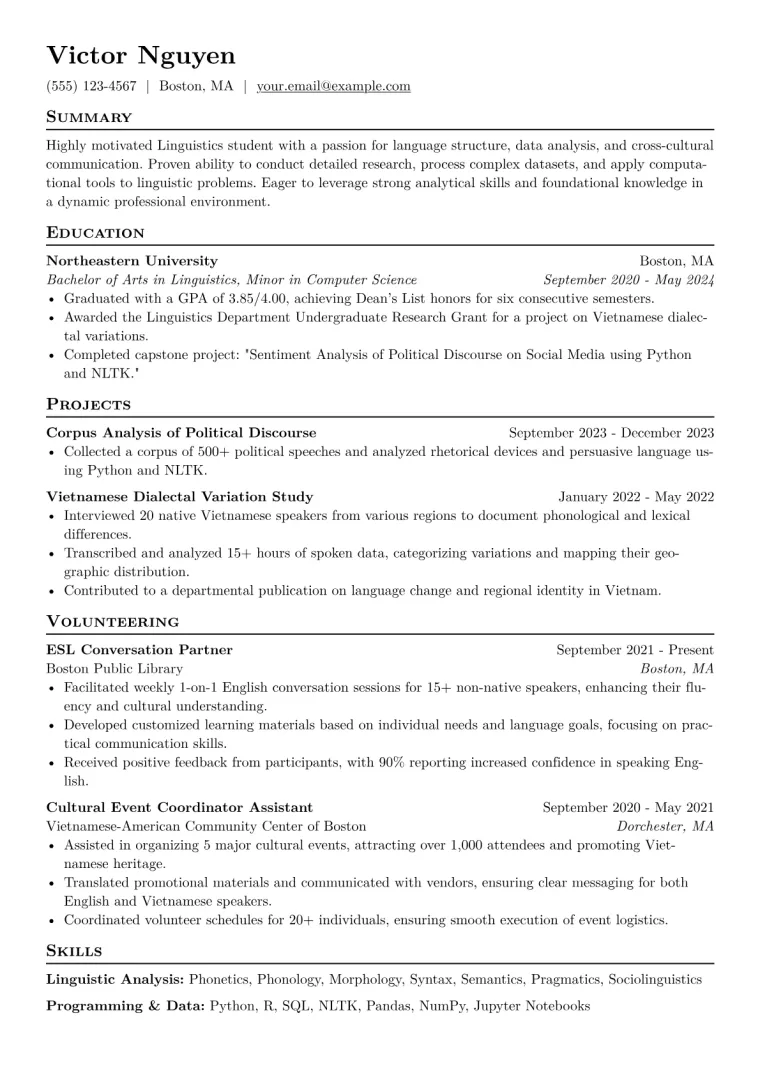
Computational Linguist Resume Example
 Example by JobSprout
Free to use. No download fee.
Market Insights
Computational Linguist
Salary Range
Salary Trend
12-Month Trend
Based on advertised Software Engineering roles.
US market data · Source: Adzuna · Updated Mar 2026
How useful was this template?
Computational Linguist resume samples
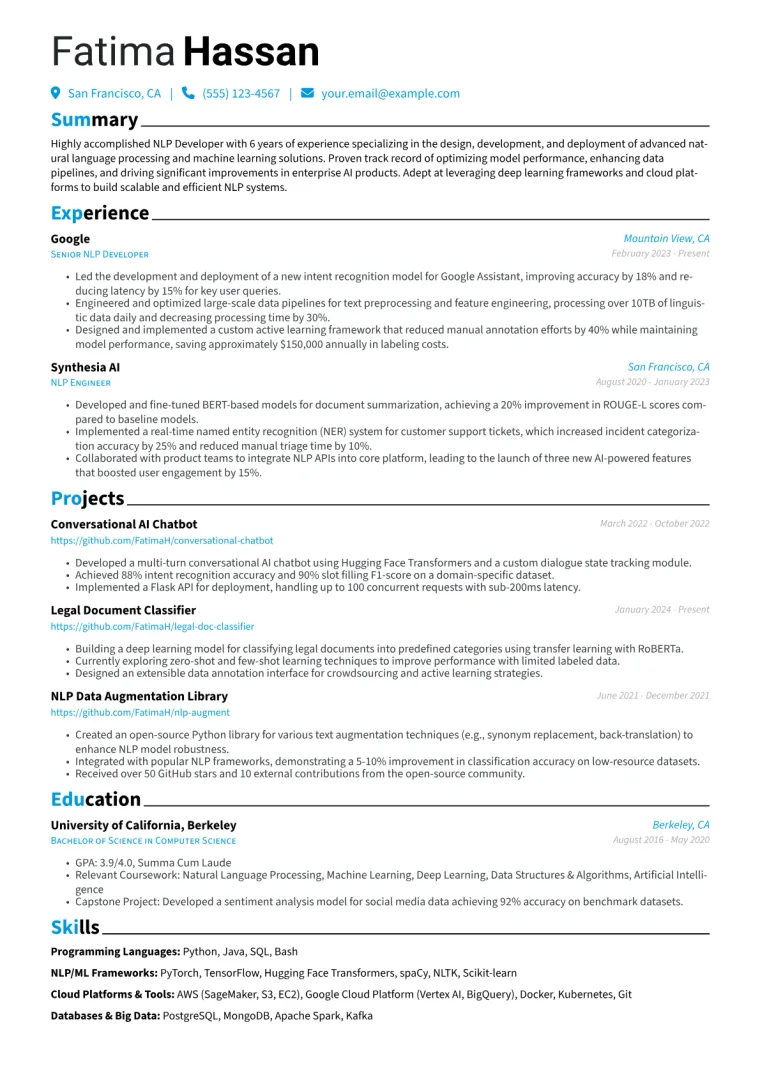
Three complete resumes, each in a different design.


Free to use. No download fee.
What makes a strong Computational Linguist resume?
US median salary $142,857 ·
Crafting a compelling Computational Linguist resume in the technology sector requires more than just listing skills. Hiring managers specifically seek evidence of impact, looking for candidates who can bridge linguistic theory with robust engineering solutions. Concrete achievements include quantifying improvements in model performance, such as increasing sentiment analysis F1 scores by X% or reducing inference latency for NLU pipelines. Highlighting expertise in Python, TensorFlow, PyTorch, and cloud platforms like AWS SageMaker, alongside an understanding of LLM fine-tuning and data annotation strategies, demonstrates direct relevance to a mid-level software engineering role focused on NLP.
Why this example works
The example CV effectively showcases these crucial elements. It strategically groups technical skills, separating programming languages from specialized NLP libraries like spaCy and Hugging Face, making a candidate's core competencies immediately apparent. Achievements are consistently quantified, illustrating tangible contributions such as “developed and deployed a text classification system, improving accuracy by 15%.” This approach clearly articulates value to potential employers, moving beyond mere task descriptions to highlight successful project ownership and measurable outcomes in a production environment.
Computational Linguist resume example (text version)
Keiko Yamamoto · Computational Linguist
Summary
A highly analytical and results-driven Computational Linguist with 6 years of experience in Natural Language Processing and Machine Learning. Proven ability to design, develop, and deploy robust NLP models for diverse applications, including sentiment analysis, information extraction, and conversational AI. Expert in leveraging linguistic theory and data-driven approaches to solve complex language understanding problems and improve product performance.
Experience
Senior Computational Linguist · Google
Mountain View, CA · 2021 - Present
- Led the development of a novel intent recognition model for conversational AI, improving accuracy by 18% and reducing false positives by 12% for a key product feature.
- Architected and implemented data pipelines for collecting and annotating large-scale linguistic datasets (1M+ utterances), increasing data efficiency by 30% and accelerating model training cycles.
- Collaborated with machine learning engineers to integrate advanced NLP techniques (e.g., transformer models) into production systems, resulting in a 25% improvement in semantic search relevance.
- Mentored junior linguists and provided technical guidance on best practices for data annotation, model evaluation, and linguistic feature engineering.
Computational Linguist · Amazon
Seattle, WA · 2017 - 2021
- Designed and implemented annotation guidelines for a named entity recognition (NER) task across 5 languages, achieving an inter-annotator agreement (IAA) of 0.85 F1-score.
- Developed and fine-tuned BERT-based models for sentiment analysis on customer reviews, leading to a 15% increase in accuracy over previous rule-based systems.
- Contributed to the improvement of an internal knowledge graph by extracting and normalizing over 500,000 product attributes from unstructured text, enhancing data quality by 20%.
- Automated linguistic quality assurance processes using Python and NLTK, reducing manual review time by 40% and identifying critical data inconsistencies across datasets.
Education
M.S. in Computational Linguistics · University of Washington
Seattle, WA · 2015 - 2017
- Graduated with a 3.9/4.0 GPA, specializing in statistical and neural NLP models
- Thesis: 'Neural Machine Translation for Low-Resource Languages using Transfer Learning'
- Recipient of the Departmental Excellence Award for outstanding graduate research
B.A. in Linguistics · University of California, Berkeley
Berkeley, CA · 2011 - 2015
- Graduated Magna Cum Laude with a focus on formal semantics and pragmatics
- Published undergraduate research on cross-linguistic semantic analysis of spatial prepositions
- President of the Linguistics Student Association, organizing weekly research seminars
Skills
Computational Linguist resume example: Clinical NLP Specialist
Tomasz Kowalski · Computational Linguist
Summary
A dedicated and innovative Computational Linguist with 7 years of experience specializing in clinical and biomedical Natural Language Processing. Expertise in developing robust NLP models for extracting structured information from unstructured medical text, enhancing clinical decision support, and streamlining healthcare data analysis. Proven ability to leverage linguistic theory and machine learning to build high-performance solutions for complex healthcare challenges, improving patient outcomes and operational efficiency.
Experience
Lead Computational Linguist · BioLinguistics Corp.
Boston, MA · 2021 - Present
- Led a team of 4 NLP engineers to develop and deploy a cutting-edge clinical entity extraction system, improving extraction accuracy by 18% (F1-score 0.89) for key medical concepts from EHRs.
- Architected and implemented a high-throughput pipeline for processing over 1 million clinical notes daily, reducing processing time by 35% and supporting real-time decision support applications.
- Designed and validated custom NLP models for pharmacovigilance, automatically identifying adverse drug reactions with 92% precision, leading to a 25% reduction in manual review effort.
- Mentored junior computational linguists and contributed to strategic planning for long-term NLP research and product development initiatives.
Computational Linguist · Epic Systems
Verona, WI · 2018 - 2021
- Developed and maintained NLP components for Epic's electronic health record (EHR) system, improving the structured data extraction rate from unstructured clinical narratives by 15%.
- Applied machine learning techniques (e.g., BERT, LSTMs) to build models for identifying patient conditions and medical procedures, achieving 90%+ accuracy on internal benchmarks.
- Collaborated with clinical informaticists and software engineers to translate complex medical requirements into robust NLP solutions, resulting in the successful integration of 3 new features into the EHR platform.
- Optimized existing NLP algorithms, reducing inference time by 20% on critical applications, which enhanced the responsiveness of physician-facing tools.
Education
Ph.D. in Computational Linguistics · University of Pennsylvania
Philadelphia, PA · 2014 - 2018
- Dissertation: 'Automated Phenotyping from Electronic Health Records using Deep Learning and Semantic Parsing'
- Achieved GPA of 3.9/4.0, awarded Presidential Fellowship for research excellence.
- Published 3 peer-reviewed articles in top-tier NLP and Biomedical Informatics conferences.
M.S. in Computer Science · University of Illinois Urbana-Champaign
Urbana, IL · 2012 - 2014
- Specialization in Artificial Intelligence, focusing on Natural Language Processing.
- Thesis: 'Topic Modeling for Clinical Trial Documents and Adverse Event Detection'.
- Graduated with High Honors, GPA of 3.8/4.0.
Skills
Computational Linguist resume example: Career Changer
Priya Sharma · Computational Linguist
Summary
A detail-oriented Computational Linguist with 6 years of combined experience spanning linguistic analysis, data science, and Natural Language Processing. Successfully transitioned expertise in language structure and data interpretation into developing robust NLP solutions that significantly enhance product capabilities and user experience. Proven ability to translate complex linguistic challenges into actionable machine learning strategies, driving measurable impact across diverse applications.
Experience
Computational Linguist II · Duolingo
Pittsburgh, PA · 2023 - Present
- Designed and implemented annotation guidelines for novel language learning tasks, increasing data annotation throughput by 20% while maintaining 95% inter-annotator agreement.
- Developed and fine-tuned transformer-based models for grammatical error correction, leading to a 12% improvement in student writing assessment accuracy.
- Collaborated with engineers to deploy NLP features into production, reducing inference latency by 8% for critical user-facing feedback loops.
- Conducted A/B testing on new pedagogical features, demonstrating a 5% increase in user engagement for target language groups.
Computational Linguist · Cerence Inc.
Burlington, MA · 2021 - 2022
- Analyzed large-scale speech data to identify linguistic patterns and improve Automatic Speech Recognition (ASR) performance, reducing error rates by 7% for in-car voice assistants.
- Developed custom NLP components for intent recognition and entity extraction, enhancing natural language understanding in automotive infotainment systems.
- Authored comprehensive linguistic specifications and lexicons for 3 new language variants, accelerating product localization timelines by 15%.
- Utilized Python and NLTK to script data cleaning and pre-processing routines, improving efficiency of data preparation by 25% for model training.
Junior Data Analyst · Wayfair
Boston, MA · 2019 - 2020
- Developed SQL queries and Python scripts to analyze customer behavior data, improving marketing campaign targeting efficiency by 15%.
- Created interactive dashboards using Tableau to visualize key performance indicators, providing stakeholders with actionable insights.
- Contributed to data quality initiatives, identifying and resolving discrepancies in product catalog data which reduced customer support tickets by 10%.
- Performed ad-hoc data analysis to support product development decisions, directly influencing the iteration of 2 new e-commerce features.
Education
M.S. in Computational Linguistics · University of Washington
Seattle, WA · 2019 - 2021
- Specialized in statistical NLP, machine learning for text, and linguistic annotation.
- Thesis: 'Cross-Lingual Transfer Learning for Low-Resource Named Entity Recognition'
- GPA: 3.9/4.0
B.A. in Linguistics (Minor in Computer Science) · University of Massachusetts Amherst
Amherst, MA · 2015 - 2019
- Focused on syntax, semantics, and phonology with practical application in programming.
- Awarded departmental honors for research on dialectal variation in American English.
- Graduated Magna Cum Laude, GPA: 3.8/4.0
Skills
How useful was this template?
Example by JobSprout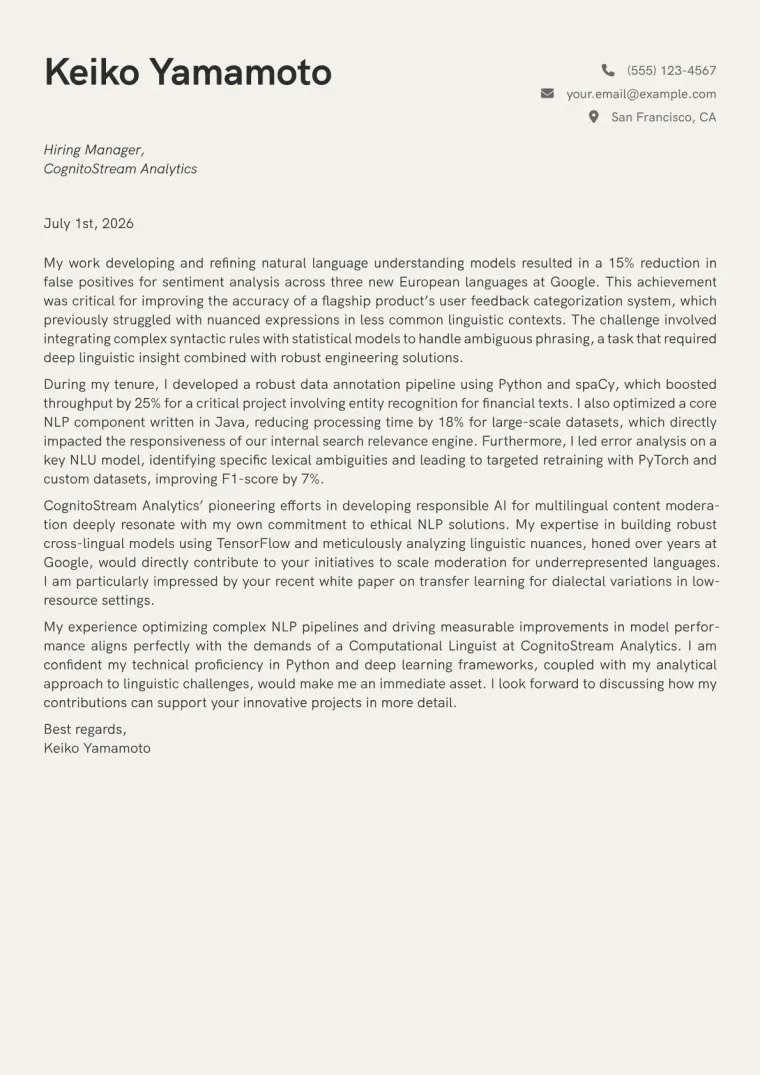
Computational Linguist Cover Letter Example
Written for the same person as this resume, ready to adapt.
Computational Linguist resume summary example
A highly analytical and results-driven Computational Linguist with 6 years of experience in Natural Language Processing and Machine Learning. Proven ability to design, develop, and deploy robust NLP models for diverse applications, including sentiment analysis, information extraction, and conversational AI. Expert in leveraging linguistic theory and data-driven approaches to solve complex language understanding problems and improve product performance.
Computational Linguist salary by country
| Country | 25th percentile | Median | 75th percentile |
|---|---|---|---|
| US | $110,000 | $142,857 | $151,429 |
| UK | £46,059 | £60,012 | £72,658 |
| Canada | C$86,152 | C$113,871 | C$140,800 |
| Australia | A$101,935 | A$126,667 | A$147,857 |
| Germany | €59,500 | €70,570 | €77,887 |
| France | €37,875 | €44,167 | €49,750 |
| Netherlands | €55,000 | €66,667 | €74,250 |
| Italy | €25,000 | €31,250 | €38,750 |
| Austria | €46,250 | €58,750 | €67,500 |
| New Zealand | NZ$102,500 | NZ$120,000 | NZ$162,500 |
| India | ₹1,125,000 | ₹1,750,000 | ₹3,500,000 |
| Poland | zł186,440 | zł209,338 | zł232,236 |
Annual salaries in local currency, aggregated from live job postings via Adzuna. Figures refresh continuously and reflect advertised pay, not negotiated offers.
Computational Linguist resume skills and keywords
Recruiters and applicant tracking systems scan Computational Linguist resumes for these skills and keywords. Include the ones that match your experience and mirror the wording in the job description. Check your resume against them with the free ATS checker.
Hard skills
Tools & software
Certifications
Soft skills
Market Insights
Computational Linguist
Salary Range
Salary Trend
12-Month Trend
Based on advertised Software Engineering roles.
US market data · Source: Adzuna · Updated Mar 2026
Frequently Asked Questions
What's the best resume structure for a mid-level Computational Linguist?
Which key skills and qualifications should I highlight as a Computational Linguist?
How do I write strong achievement bullets or a compelling professional summary for this role?
What optional sections are important for a Computational Linguist resume?
How can I effectively tailor this resume template for a specific Computational Linguist job opening?
The blank page is the hard part. Skip it.
Free to use. No download fee.
Related Articles

How to Write a CV for Tech Applications [2026 Guide]
Learn how to write a software engineering CV that gets interviews. Real template analysis, what hiring managers look for, and common mistakes to avoid.

How to Write a CV That Shows Startup Experience [2026 Guide]
Learn how to write a CV that showcases founding engineer and startup experience. Real example from JobSprout's creator, what hiring managers look for, and how to position breadth as a strength.