Medical Device Engineer Resume Example
 Example by JobSprout
Free to use. No download fee.
Market Insights
Medical Device Engineer
Salary Range
Salary Trend
12-Month Trend
Based on advertised Healthcare (Clinical) roles.
US market data · Source: Adzuna · Updated Mar 2026
How useful was this template?
Medical Device Engineer resume samples
Three complete resumes, each in a different design.
Free to use. No download fee.
What makes a strong Medical Device Engineer resume?
US median salary $101,053 ·
A strong Medical Device Engineer resume in healthcare distinctly highlights regulatory compliance, patient safety, and clinical impact. Hiring managers prioritize experience navigating FDA QSR and ISO 13485, alongside expertise in design controls, risk management, and validation protocols like IQ, OQ, PQ. Concrete achievements include successful device submissions, optimized manufacturing processes that reduced defect rates, or direct contributions to clinical trials. Mentioning specific device types, biocompatibility studies, or sterilization methods further demonstrates specialized knowledge critical to this demanding field.
Why this example works
This JobSprout resume example effectively showcases these competencies. Achievements are quantified, detailing the scope and impact of projects, such as “reduced design cycle time by 15%.” Technical skills are logically grouped into categories like “Regulatory & Quality Systems,” “Design & Analysis Tools,” and “Prototyping & Testing,” making them easily digestible. Key certifications, such as Six Sigma Green Belt or relevant ASQ qualifications, are prominently displayed, alongside proficiency in industry-standard software like SolidWorks, MATLAB, or Minitab, reflecting true medical device engineering expertise.
Medical Device Engineer resume example (text version)
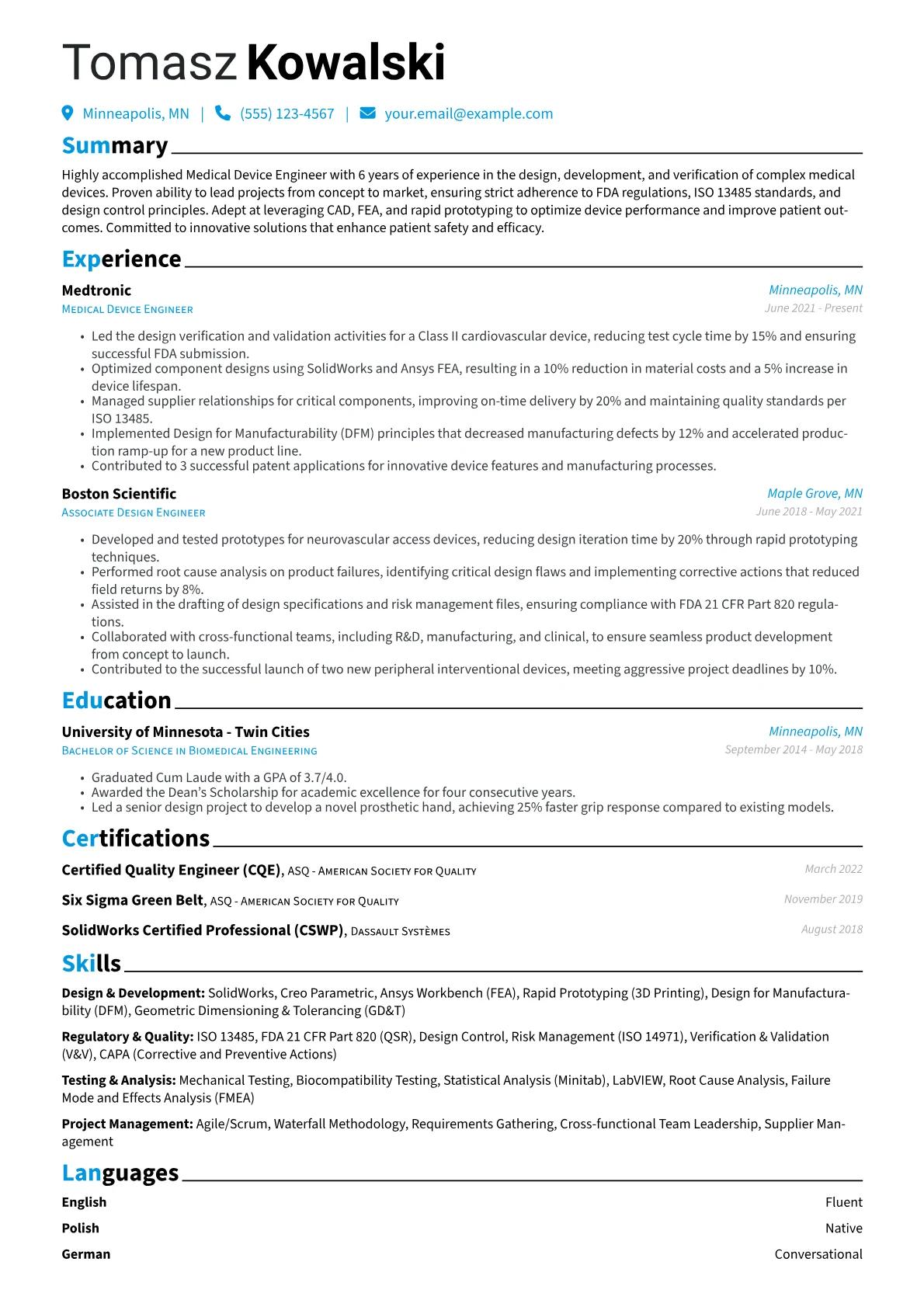
Tomasz Kowalski · Medical Device Engineer
Summary
Highly accomplished Medical Device Engineer with 6 years of experience in the design, development, and verification of complex medical devices. Proven ability to lead projects from concept to market, ensuring strict adherence to FDA regulations, ISO 13485 standards, and design control principles. Adept at leveraging CAD, FEA, and rapid prototyping to optimize device performance and improve patient outcomes. Committed to innovative solutions that enhance patient safety and efficacy.
Experience
Medical Device Engineer · Medtronic
Minneapolis, MN · 2021 - Present
- Led the design verification and validation activities for a Class II cardiovascular device, reducing test cycle time by 15% and ensuring successful FDA submission.
- Optimized component designs using SolidWorks and Ansys FEA, resulting in a 10% reduction in material costs and a 5% increase in device lifespan.
- Managed supplier relationships for critical components, improving on-time delivery by 20% and maintaining quality standards per ISO 13485.
- Implemented Design for Manufacturability (DFM) principles that decreased manufacturing defects by 12% and accelerated production ramp-up for a new product line.
- Contributed to 3 successful patent applications for innovative device features and manufacturing processes.
Associate Design Engineer · Boston Scientific
Maple Grove, MN · 2018 - 2021
- Developed and tested prototypes for neurovascular access devices, reducing design iteration time by 20% through rapid prototyping techniques.
- Performed root cause analysis on product failures, identifying critical design flaws and implementing corrective actions that reduced field returns by 8%.
- Assisted in the drafting of design specifications and risk management files, ensuring compliance with FDA 21 CFR Part 820 regulations.
- Collaborated with cross-functional teams, including R&D, manufacturing, and clinical, to ensure seamless product development from concept to launch.
- Contributed to the successful launch of two new peripheral interventional devices, meeting aggressive project deadlines by 10%.
Education
Bachelor of Science in Biomedical Engineering · University of Minnesota - Twin Cities
Minneapolis, MN · 2014 - 2018
- Graduated Cum Laude with a GPA of 3.7/4.0.
- Awarded the Dean's Scholarship for academic excellence for four consecutive years.
- Led a senior design project to develop a novel prosthetic hand, achieving 25% faster grip response compared to existing models.
Skills
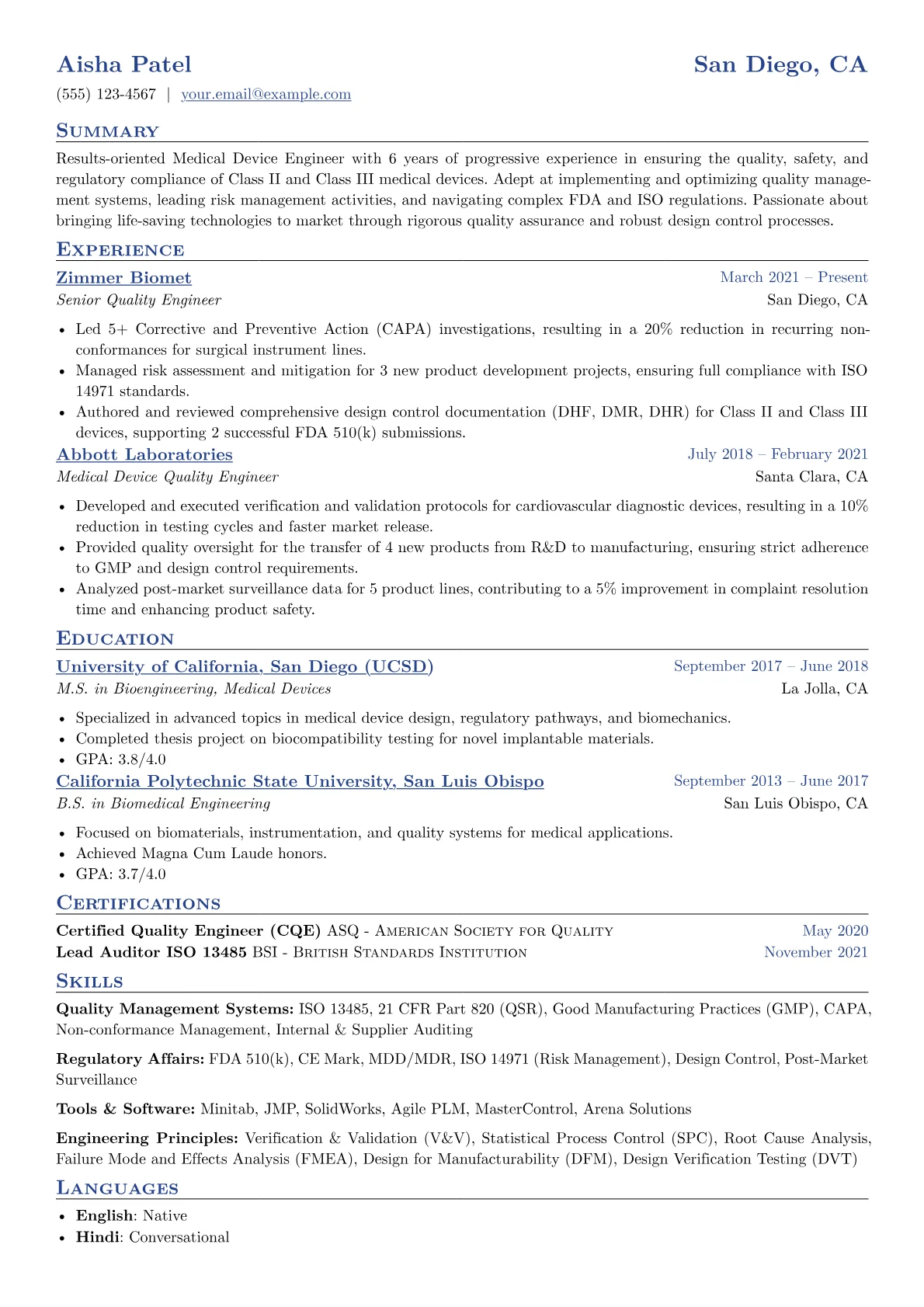
Medical Device Engineer resume example: Quality Management Systems
Aisha Patel · Medical Device Engineer
Summary
Results-oriented Medical Device Engineer with 6 years of progressive experience in ensuring the quality, safety, and regulatory compliance of Class II and Class III medical devices. Adept at implementing and optimizing quality management systems, leading risk management activities, and navigating complex FDA and ISO regulations. Passionate about bringing life-saving technologies to market through rigorous quality assurance and robust design control processes.
Experience
Senior Quality Engineer · Zimmer Biomet
San Diego, CA · 2021 - Present
- Led 5+ Corrective and Preventive Action (CAPA) investigations, resulting in a 20% reduction in recurring non-conformances for surgical instrument lines.
- Managed risk assessment and mitigation for 3 new product development projects, ensuring full compliance with ISO 14971 standards.
- Authored and reviewed comprehensive design control documentation (DHF, DMR, DHR) for Class II and Class III devices, supporting 2 successful FDA 510(k) submissions.
- Conducted internal and supplier audits for 10+ critical suppliers, identifying 15+ areas for improvement and strengthening supply chain quality by 15%.
Medical Device Quality Engineer · Abbott Laboratories
Santa Clara, CA · 2018 - 2021
- Developed and executed verification and validation protocols for cardiovascular diagnostic devices, resulting in a 10% reduction in testing cycles and faster market release.
- Provided quality oversight for the transfer of 4 new products from R&D to manufacturing, ensuring strict adherence to GMP and design control requirements.
- Analyzed post-market surveillance data for 5 product lines, contributing to a 5% improvement in complaint resolution time and enhancing product safety.
- Collaborated with cross-functional teams to resolve 25+ complex quality issues, preventing potential product recalls and ensuring continuous market access.
Education
M.S. in Bioengineering, Medical Devices · University of California, San Diego (UCSD)
La Jolla, CA · 2017 - 2018
- Specialized in advanced topics in medical device design, regulatory pathways, and biomechanics.
- Completed thesis project on biocompatibility testing for novel implantable materials.
- GPA: 3.8/4.0
B.S. in Biomedical Engineering · California Polytechnic State University, San Luis Obispo
San Luis Obispo, CA · 2013 - 2017
- Focused on biomaterials, instrumentation, and quality systems for medical applications.
- Achieved Magna Cum Laude honors.
- GPA: 3.7/4.0
Skills
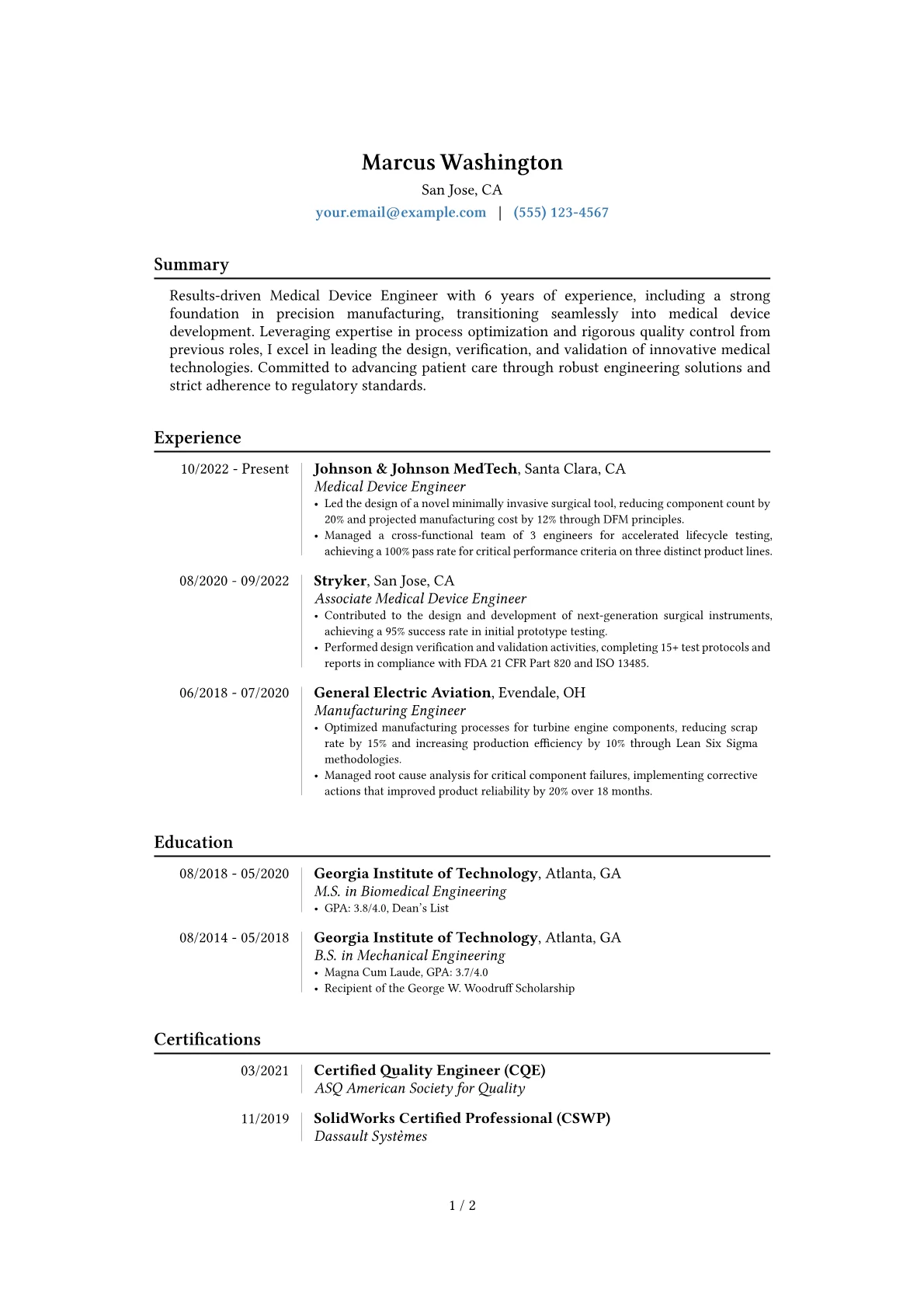
Medical Device Engineer resume example: Career Changer
Marcus Washington · Medical Device Engineer
Summary
Results-driven Medical Device Engineer with 6 years of experience, including a strong foundation in precision manufacturing, transitioning seamlessly into medical device development. Leveraging expertise in process optimization and rigorous quality control from previous roles, I excel in leading the design, verification, and validation of innovative medical technologies. Committed to advancing patient care through robust engineering solutions and strict adherence to regulatory standards.
Experience
Medical Device Engineer · Johnson & Johnson MedTech
Santa Clara, CA · 2022 - Present
- Led the design of a novel minimally invasive surgical tool, reducing component count by 20% and projected manufacturing cost by 12% through DFM principles.
- Managed a cross-functional team of 3 engineers for accelerated lifecycle testing, achieving a 100% pass rate for critical performance criteria on three distinct product lines.
- Authored and executed design control documentation including DHF, V&V plans, and risk assessments for Class II and Class III medical devices.
- Implemented process improvements for material selection and sterilization compatibility, resulting in a 5% reduction in material waste and enhanced product biocompatibility.
Associate Medical Device Engineer · Stryker
San Jose, CA · 2020 - 2022
- Contributed to the design and development of next-generation surgical instruments, achieving a 95% success rate in initial prototype testing.
- Performed design verification and validation activities, completing 15+ test protocols and reports in compliance with FDA 21 CFR Part 820 and ISO 13485.
- Utilized SolidWorks and ANSYS for mechanical design and simulation, identifying critical stress points and improving device durability by 18%.
- Supported risk management activities, contributing to FMEA and PMEA analyses for two Class II medical devices.
Manufacturing Engineer · General Electric Aviation
Evendale, OH · 2018 - 2020
- Optimized manufacturing processes for turbine engine components, reducing scrap rate by 15% and increasing production efficiency by 10% through Lean Six Sigma methodologies.
- Managed root cause analysis for critical component failures, implementing corrective actions that improved product reliability by 20% over 18 months.
- Developed and validated new fixture designs using SolidWorks, decreasing setup times by an average of 25% for complex assemblies.
- Collaborated with R&D teams to transition new product designs into production, ensuring manufacturability and adherence to stringent aerospace quality standards.
Education
M.S. in Biomedical Engineering · Georgia Institute of Technology
Atlanta, GA · 2018 - 2020
- GPA: 3.8/4.0, Dean's List
B.S. in Mechanical Engineering · Georgia Institute of Technology
Atlanta, GA · 2014 - 2018
- Magna Cum Laude, GPA: 3.7/4.0
- Recipient of the George W. Woodruff Scholarship
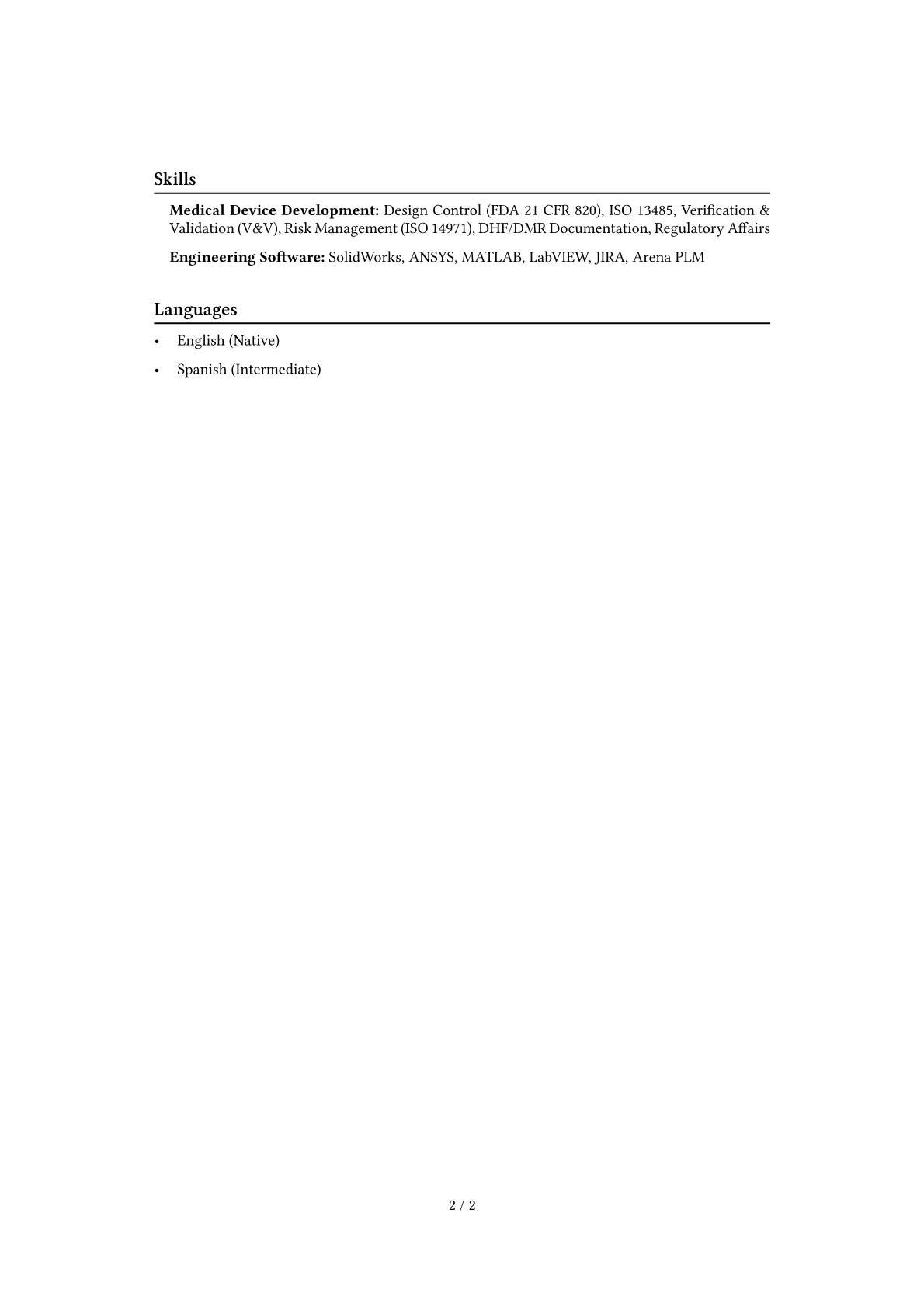
Skills
How useful was this template?
Example by JobSproutMedical Device Engineer resume summary example
Highly accomplished Medical Device Engineer with 6 years of experience in the design, development, and verification of complex medical devices. Proven ability to lead projects from concept to market, ensuring strict adherence to FDA regulations, ISO 13485 standards, and design control principles. Adept at leveraging CAD, FEA, and rapid prototyping to optimize device performance and improve patient outcomes. Committed to innovative solutions that enhance patient safety and efficacy.
Medical Device Engineer salary by country
| Country | 25th percentile | Median | 75th percentile |
|---|---|---|---|
| US | $88,182 | $101,053 | $132,000 |
| UK | £45,000 | £54,545 | £68,750 |
| Canada | C$86,152 | C$113,871 | C$140,800 |
| Australia | A$101,935 | A$126,667 | A$147,857 |
| Germany | €59,500 | €70,570 | €77,887 |
| France | €37,875 | €44,167 | €49,750 |
| Netherlands | €55,000 | €66,667 | €74,250 |
| Italy | €25,000 | €31,250 | €38,750 |
| Austria | €46,250 | €58,750 | €67,500 |
| New Zealand | NZ$102,500 | NZ$120,000 | NZ$162,500 |
| India | ₹300,000 | ₹600,000 | ₹900,000 |
| Poland | zł186,440 | zł209,338 | zł232,236 |
Annual salaries in local currency, aggregated from live job postings via Adzuna. Figures refresh continuously and reflect advertised pay, not negotiated offers.
Medical Device Engineer resume skills and keywords
Recruiters and applicant tracking systems scan Medical Device Engineer resumes for these skills and keywords. Include the ones that match your experience and mirror the wording in the job description. Check your resume against them with the free ATS checker.
Hard skills
Tools & software
Certifications
Soft skills
Market Insights
Medical Device Engineer
Salary Range
Salary Trend
12-Month Trend
Based on advertised Healthcare (Clinical) roles.
US market data · Source: Adzuna · Updated Mar 2026
Frequently Asked Questions
What's the best resume structure for a mid-level Medical Device Engineer?
Which skills and qualifications should I emphasize as a Medical Device Engineer?
How can I write strong achievement bullets or a professional summary for this role?
Are there any optional sections that truly matter for a Medical Device Engineer?
How do I tailor my Medical Device Engineer resume for a specific job posting?
The blank page is the hard part. Skip it.
Free to use. No download fee.
Related Articles

How to Write a CV for Healthcare Applications [2026 Guide]
Learn how to write a nursing CV that gets interviews. Real template analysis, what clinical hiring managers look for, and common mistakes to avoid.

Medical Assistant Resume Examples and Templates (2026)
Complete guide to writing a medical assistant resume that gets interviews. Includes full resume example, clinical and admin skill lists, certification table, and ATS keywords for 2026.
Career moves from Medical Device Engineer
Usually need less experience or training
Includes information from the O*NET 30.3 Database by the U.S. Department of Labor, Employment and Training Administration (USDOL/ETA), used under the CC BY 4.0 license. We have modified it; USDOL/ETA has not approved, endorsed or tested these modifications. O*NET is a trademark of USDOL/ETA.