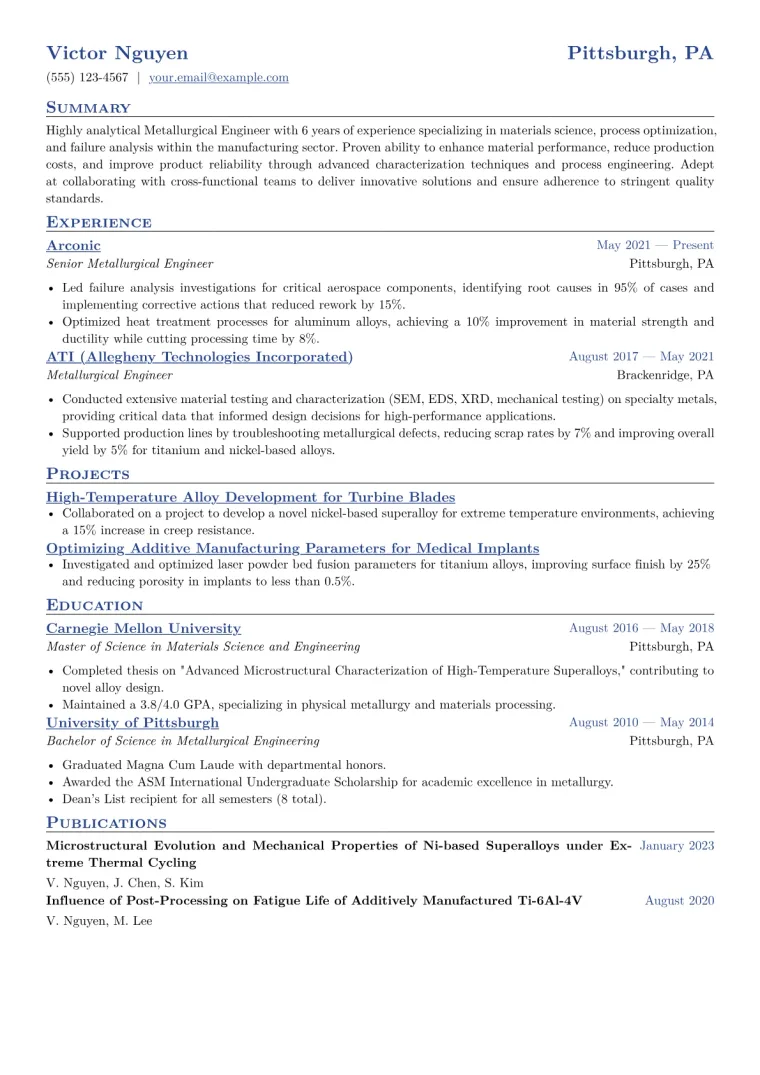
Photonics Engineer Resume Example
 Example by JobSprout
Free to use. No download fee.
Market Insights
Photonics Engineer
Salary Range
Salary Trend
12-Month Trend
Based on advertised Engineering roles.
US market data · Source: Adzuna · Updated Sep 2026
How useful was this template?
Photonics Engineer resume samples
Three complete resumes, each in a different design.
Free to use. No download fee.
What makes a strong Photonics Engineer resume?
US median salary $161,071 ·
Hiring managers for mid-level Photonics Engineers in manufacturing prioritize candidates who demonstrate tangible impact on production efficiency and product quality. They specifically look for experience in optimizing optical systems for industrial processes, implementing laser material processing, and developing advanced metrology solutions for production lines. Achievements should detail quantifiable improvements in yield, throughput, or defect reduction. Expertise with design for manufacturability (DFM), cleanroom protocols, and relevant certifications such as Lean Six Sigma or specific ISO standards are highly valued, along with terminology like “optical system integration,” “process control,” and “spectroscopic analysis.”
Why this example works
The JobSprout example resume effectively structures these vital qualifications. It explicitly quantifies achievements, such as “optimized laser-welding parameters, reducing material waste by 18% and improving throughput by 12%.” Skills are thoughtfully grouped into categories like “Optical Design & Simulation (Zemax, LightTools),” “Process Engineering (Lean Manufacturing, SPC),” and “Metrology (Interferometry, Spectroscopy).” Certifications, including “Certified Lean Six Sigma Green Belt,” and essential tools like “SolidWorks” and “Python” are prominently highlighted, catering directly to manufacturing industry expectations.
Photonics Engineer resume example (text version)
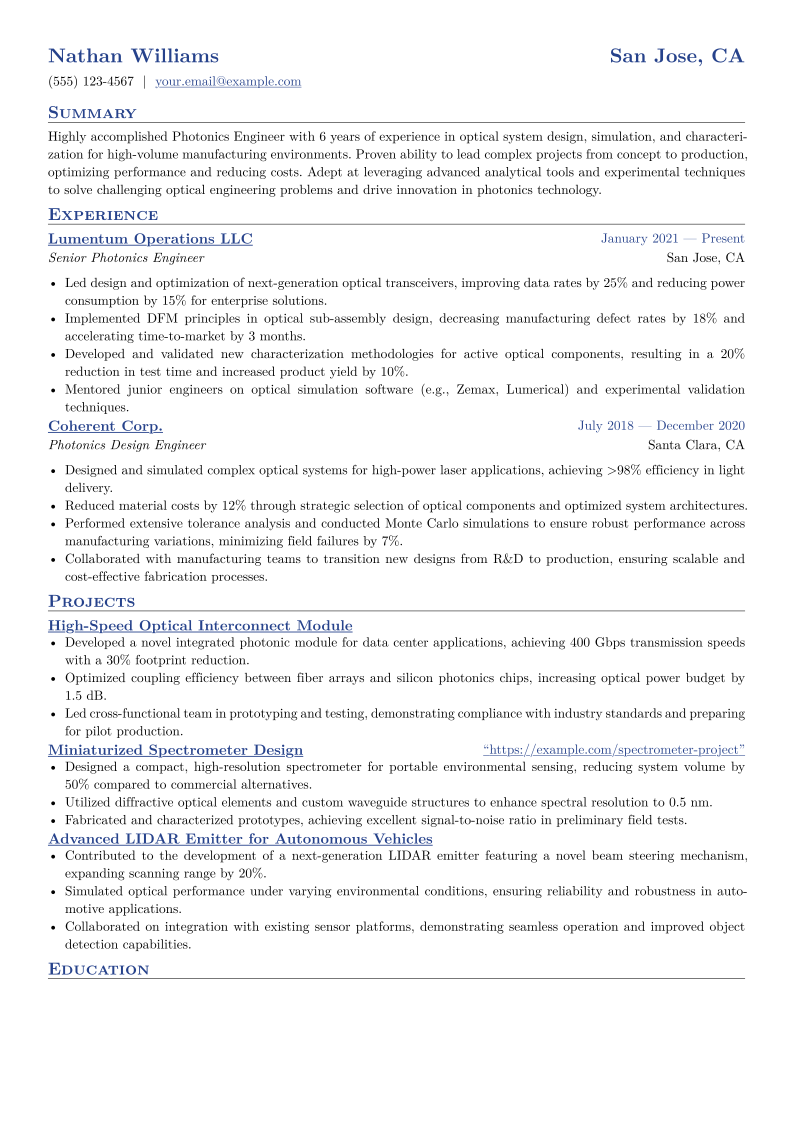
Nathan Williams · Photonics Engineer
Summary
Highly accomplished Photonics Engineer with 6 years of experience in optical system design, simulation, and characterization for high-volume manufacturing environments. Proven ability to lead complex projects from concept to production, optimizing performance and reducing costs. Adept at leveraging advanced analytical tools and experimental techniques to solve challenging optical engineering problems and drive innovation in photonics technology.
Experience
Senior Photonics Engineer · Lumentum Operations LLC
San Jose, CA · 2021 - Present
- Led design and optimization of next-generation optical transceivers, improving data rates by 25% and reducing power consumption by 15% for enterprise solutions.
- Implemented DFM principles in optical sub-assembly design, decreasing manufacturing defect rates by 18% and accelerating time-to-market by 3 months.
- Developed and validated new characterization methodologies for active optical components, resulting in a 20% reduction in test time and increased product yield by 10%.
- Mentored junior engineers on optical simulation software (e.g., Zemax, Lumerical) and experimental validation techniques.
Photonics Design Engineer · Coherent Corp.
Santa Clara, CA · 2018 - 2020
- Designed and simulated complex optical systems for high-power laser applications, achieving >98% efficiency in light delivery.
- Reduced material costs by 12% through strategic selection of optical components and optimized system architectures.
- Performed extensive tolerance analysis and conducted Monte Carlo simulations to ensure robust performance across manufacturing variations, minimizing field failures by 7%.
- Collaborated with manufacturing teams to transition new designs from R&D to production, ensuring scalable and cost-effective fabrication processes.
Education
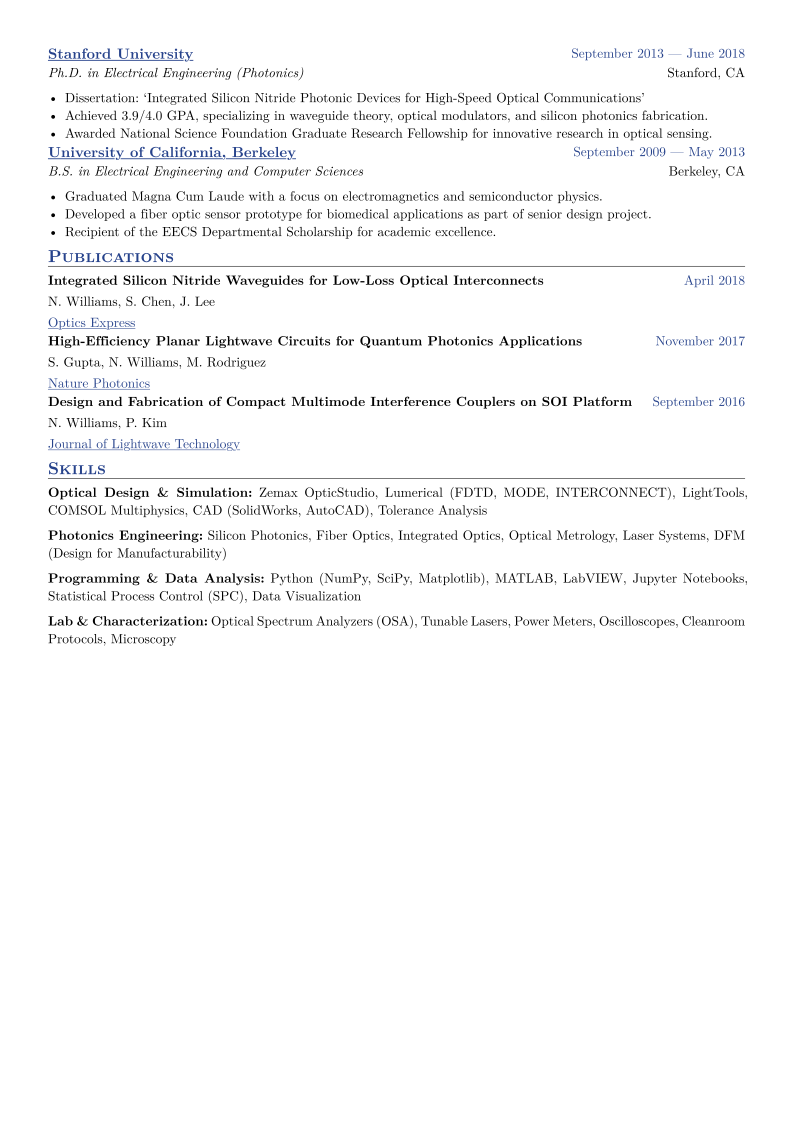
Ph.D. in Electrical Engineering (Photonics) · Stanford University
Stanford, CA · 2013 - 2018
- Dissertation: 'Integrated Silicon Nitride Photonic Devices for High-Speed Optical Communications'
- Achieved 3.9/4.0 GPA, specializing in waveguide theory, optical modulators, and silicon photonics fabrication.
- Awarded National Science Foundation Graduate Research Fellowship for innovative research in optical sensing.
B.S. in Electrical Engineering and Computer Sciences · University of California, Berkeley
Berkeley, CA · 2009 - 2013
- Graduated Magna Cum Laude with a focus on electromagnetics and semiconductor physics.
- Developed a fiber optic sensor prototype for biomedical applications as part of senior design project.
- Recipient of the EECS Departmental Scholarship for academic excellence.
Skills
Photonics Engineer resume example: Integrated Photonics
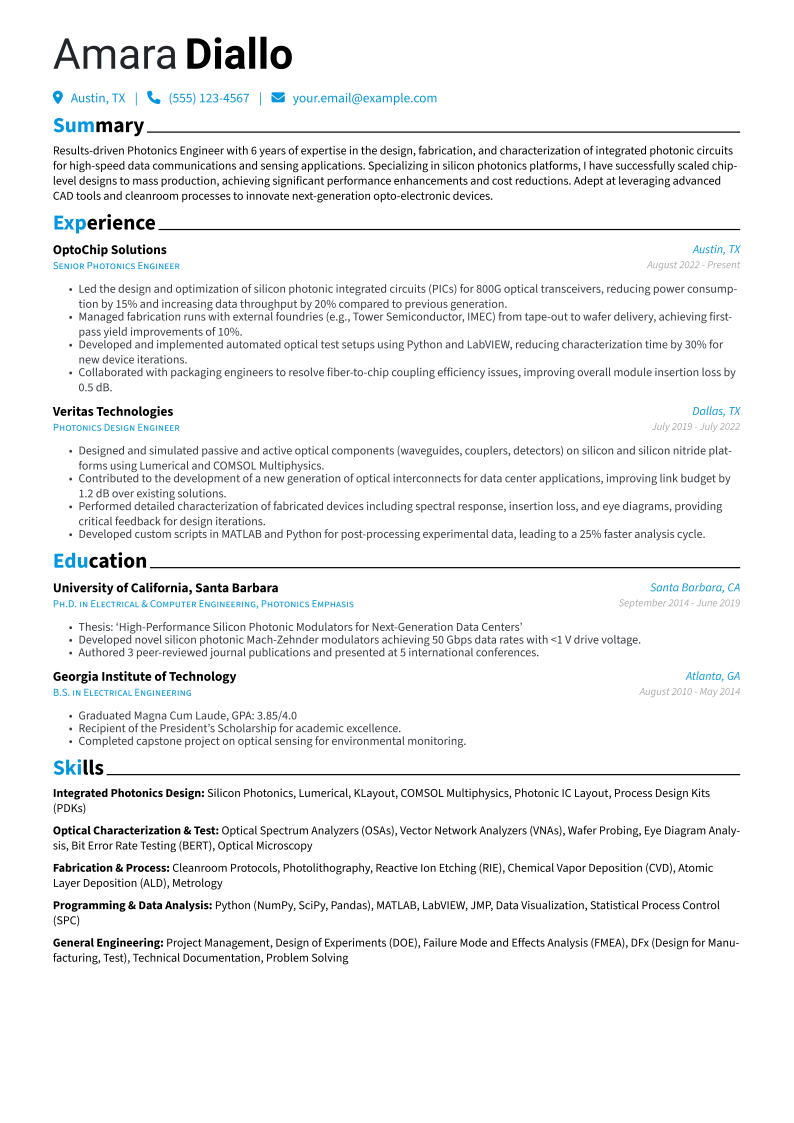
Amara Diallo · Photonics Engineer
Summary
Results-driven Photonics Engineer with 6 years of expertise in the design, fabrication, and characterization of integrated photonic circuits for high-speed data communications and sensing applications. Specializing in silicon photonics platforms, I have successfully scaled chip-level designs to mass production, achieving significant performance enhancements and cost reductions. Adept at leveraging advanced CAD tools and cleanroom processes to innovate next-generation opto-electronic devices.
Experience
Senior Photonics Engineer · OptoChip Solutions
Austin, TX · 2022 - Present
- Led the design and optimization of silicon photonic integrated circuits (PICs) for 800G optical transceivers, reducing power consumption by 15% and increasing data throughput by 20% compared to previous generation.
- Managed fabrication runs with external foundries (e.g., Tower Semiconductor, IMEC) from tape-out to wafer delivery, achieving first-pass yield improvements of 10%.
- Developed and implemented automated optical test setups using Python and LabVIEW, reducing characterization time by 30% for new device iterations.
- Collaborated with packaging engineers to resolve fiber-to-chip coupling efficiency issues, improving overall module insertion loss by 0.5 dB.
Photonics Design Engineer · Veritas Technologies
Dallas, TX · 2019 - 2022
- Designed and simulated passive and active optical components (waveguides, couplers, detectors) on silicon and silicon nitride platforms using Lumerical and COMSOL Multiphysics.
- Contributed to the development of a new generation of optical interconnects for data center applications, improving link budget by 1.2 dB over existing solutions.
- Performed detailed characterization of fabricated devices including spectral response, insertion loss, and eye diagrams, providing critical feedback for design iterations.
- Developed custom scripts in MATLAB and Python for post-processing experimental data, leading to a 25% faster analysis cycle.
Education
Ph.D. in Electrical & Computer Engineering, Photonics Emphasis · University of California, Santa Barbara
Santa Barbara, CA · 2014 - 2019
- Thesis: 'High-Performance Silicon Photonic Modulators for Next-Generation Data Centers'
- Developed novel silicon photonic Mach-Zehnder modulators achieving 50 Gbps data rates with <1 V drive voltage.
- Authored 3 peer-reviewed journal publications and presented at 5 international conferences.
B.S. in Electrical Engineering · Georgia Institute of Technology
Atlanta, GA · 2010 - 2014
- Graduated Magna Cum Laude, GPA: 3.85/4.0
- Recipient of the President's Scholarship for academic excellence.
- Completed capstone project on optical sensing for environmental monitoring.
Skills
Photonics Engineer resume example: Career Changer
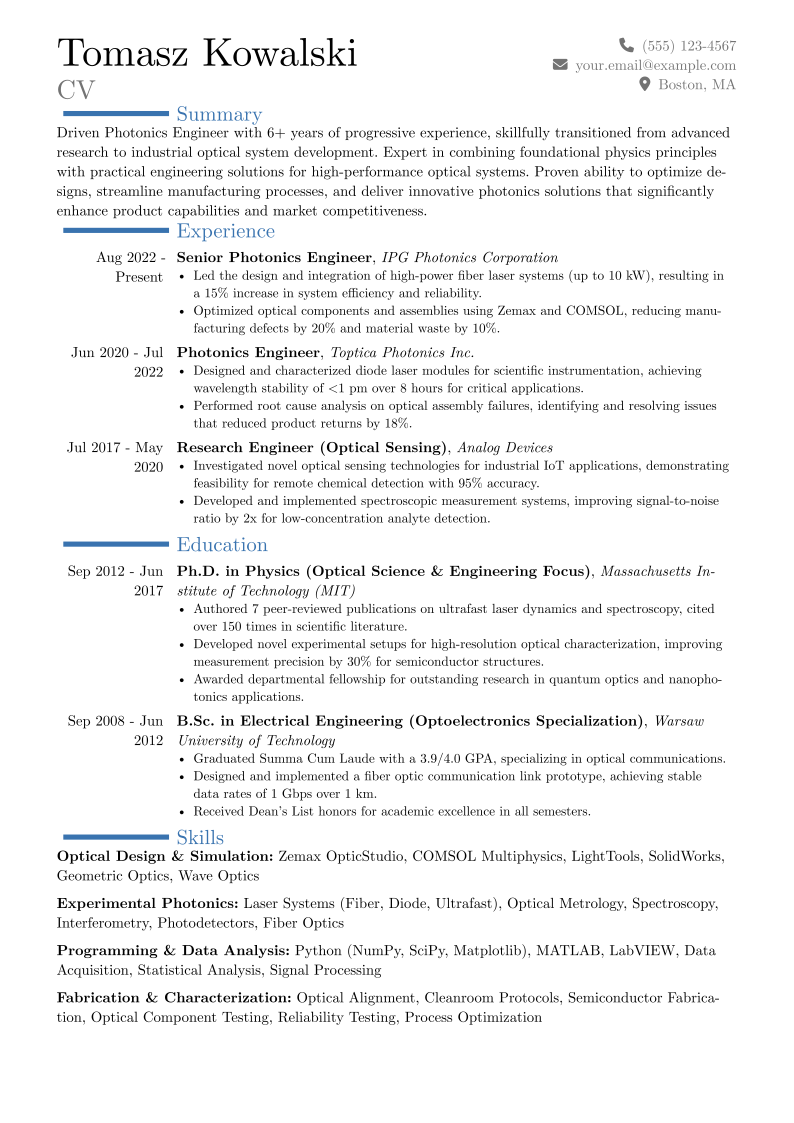
Tomasz Kowalski · Photonics Engineer
Summary
Driven Photonics Engineer with 6+ years of progressive experience, skillfully transitioned from advanced research to industrial optical system development. Expert in combining foundational physics principles with practical engineering solutions for high-performance optical systems. Proven ability to optimize designs, streamline manufacturing processes, and deliver innovative photonics solutions that significantly enhance product capabilities and market competitiveness.
Experience
Senior Photonics Engineer · IPG Photonics Corporation
Marlborough, MA · 2022 - Present
- Led the design and integration of high-power fiber laser systems (up to 10 kW), resulting in a 15% increase in system efficiency and reliability.
- Optimized optical components and assemblies using Zemax and COMSOL, reducing manufacturing defects by 20% and material waste by 10%.
- Developed advanced testing protocols for novel optical amplifiers, improving characterization throughput by 25% and ensuring compliance with IEC standards.
- Mentored junior engineers on optical design principles and experimental techniques, enhancing team productivity by 10%.
Photonics Engineer · Toptica Photonics Inc.
Victor, NY · 2020 - 2022
- Designed and characterized diode laser modules for scientific instrumentation, achieving wavelength stability of <1 pm over 8 hours for critical applications.
- Performed root cause analysis on optical assembly failures, identifying and resolving issues that reduced product returns by 18%.
- Collaborated with manufacturing to streamline alignment and testing procedures, cutting production time for key products by 12%.
- Contributed to the development of custom optical setups for OEM clients, ensuring precise beam delivery and power output specifications.
Research Engineer (Optical Sensing) · Analog Devices
Wilmington, MA · 2017 - 2020
- Investigated novel optical sensing technologies for industrial IoT applications, demonstrating feasibility for remote chemical detection with 95% accuracy.
- Developed and implemented spectroscopic measurement systems, improving signal-to-noise ratio by 2x for low-concentration analyte detection.
- Programmed data acquisition and analysis routines in Python for optical sensor arrays, accelerating data processing by 40%.
- Collaborated with cross-functional teams to integrate optical sensors into miniaturized prototypes, reducing footprint by 30%.
Education
Ph.D. in Physics (Optical Science & Engineering Focus) · Massachusetts Institute of Technology (MIT)
Cambridge, MA · 2012 - 2017
- Authored 7 peer-reviewed publications on ultrafast laser dynamics and spectroscopy, cited over 150 times in scientific literature.
- Developed novel experimental setups for high-resolution optical characterization, improving measurement precision by 30% for semiconductor structures.
- Awarded departmental fellowship for outstanding research in quantum optics and nanophotonics applications.
B.Sc. in Electrical Engineering (Optoelectronics Specialization) · Warsaw University of Technology
Warsaw, Poland · 2008 - 2012
- Graduated Summa Cum Laude with a 3.9/4.0 GPA, specializing in optical communications.
- Designed and implemented a fiber optic communication link prototype, achieving stable data rates of 1 Gbps over 1 km.
- Received Dean's List honors for academic excellence in all semesters.
Skills
How useful was this template?
Example by JobSproutPhotonics Engineer resume summary example
Highly accomplished Photonics Engineer with 6 years of experience in optical system design, simulation, and characterization for high-volume manufacturing environments. Proven ability to lead complex projects from concept to production, optimizing performance and reducing costs. Adept at leveraging advanced analytical tools and experimental techniques to solve challenging optical engineering problems and drive innovation in photonics technology.
Photonics Engineer salary by country
| Country | 25th percentile | Median | 75th percentile |
|---|---|---|---|
| US | $141,317 | $161,071 | $180,826 |
| UK | £45,625 | £54,167 | £62,500 |
| Canada | C$82,500 | C$120,000 | C$148,750 |
| Australia | A$81,573 | A$97,932 | A$124,030 |
| Germany | €41,304 | €59,718 | €72,819 |
| France | €26,998 | €34,650 | €42,911 |
| Netherlands | €40,158 | €49,152 | €62,025 |
| Italy | €17,965 | €23,981 | €29,327 |
| Austria | €34,500 | €56,250 | €71,293 |
| New Zealand | NZ$78,854 | NZ$101,126 | NZ$125,255 |
| India | ₹403,908 | ₹807,816 | ₹1,539,889 |
| Poland | zł159,882 | zł198,275 | zł221,495 |
Annual salaries in local currency, aggregated from live job postings via Adzuna. Figures refresh continuously and reflect advertised pay, not negotiated offers.
Photonics Engineer resume skills and keywords
Recruiters and applicant tracking systems scan Photonics Engineer resumes for these skills and keywords. Include the ones that match your experience and mirror the wording in the job description. Check your resume against them with the free ATS checker.
Hard skills
Tools & software
Certifications
Soft skills
Market Insights
Photonics Engineer
Salary Range
Salary Trend
12-Month Trend
Based on advertised Engineering roles.
US market data · Source: Adzuna · Updated Sep 2026
Frequently Asked Questions
What's the best resume structure for a mid-level Photonics Engineer?
Which skills should I highlight as a Photonics Engineer with 3-7 years of experience?
How can I write strong achievement bullets or a professional summary that stands out?
What optional sections are important for a Photonics Engineer's resume?
How do I tailor my resume for a specific Photonics Engineer job?
The blank page is the hard part. Skip it.
Free to use. No download fee.
Related Articles

Mechanical Engineer Resume Examples and Template (2026)
Write a mechanical engineer resume that lands interviews. Resume examples, technical skills formatting, bullet point formulas with engineering metrics, and ATS tips for every experience level and specialisation.

How to Write a CV for Manufacturing Applications [2026 Guide]
Learn how to write a manufacturing or plant manager CV that gets interviews. Real template analysis, what hiring managers look for, and common mistakes to avoid.
Career moves from Photonics Engineer
Usually need more experience or training
Usually need less experience or training
Includes information from the O*NET 30.3 Database by the U.S. Department of Labor, Employment and Training Administration (USDOL/ETA), used under the CC BY 4.0 license. We have modified it; USDOL/ETA has not approved, endorsed or tested these modifications. O*NET is a trademark of USDOL/ETA.