
Summary
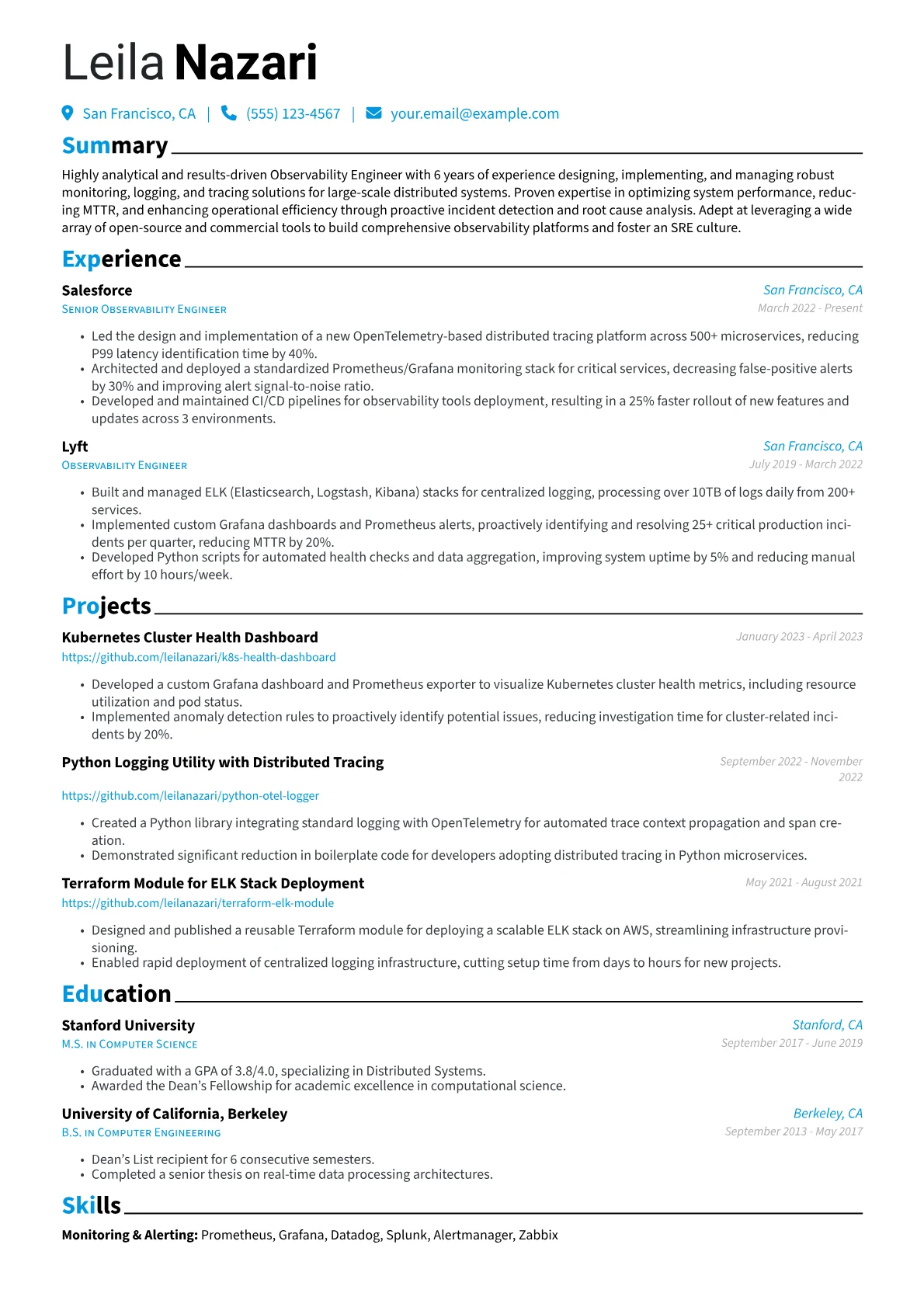
Highly analytical and results-driven Observability Engineer with 6 years of experience designing, implementing, and managing robust monitoring, logging, and tracing solutions for large-scale distributed systems. Proven expertise in optimizing system performance, reducing MTTR, and enhancing operational efficiency through proactive incident detection and root cause analysis. Adept at leveraging a wide array of open-source and commercial tools to build comprehensive observability platforms and foster an SRE culture.
Experience
Senior Observability EngineerSalesforce
- Led the design and implementation of a new OpenTelemetry-based distributed tracing platform across 500+ microservices, reducing P99 latency identification time by 40%.
- Architected and deployed a standardized Prometheus/Grafana monitoring stack for critical services, decreasing false-positive alerts by 30% and improving alert signal-to-noise ratio.
- Developed and maintained CI/CD pipelines for observability tools deployment, resulting in a 25% faster rollout of new features and updates across 3 environments.
Observability EngineerLyft
- Built and managed ELK (Elasticsearch, Logstash, Kibana) stacks for centralized logging, processing over 10TB of logs daily from 200+ services.
- Implemented custom Grafana dashboards and Prometheus alerts, proactively identifying and resolving 25+ critical production incidents per quarter, reducing MTTR by 20%.
- Developed Python scripts for automated health checks and data aggregation, improving system uptime by 5% and reducing manual effort by 10 hours/week.
Projects
Kubernetes Cluster Health Dashboard
- Developed a custom Grafana dashboard and Prometheus exporter to visualize Kubernetes cluster health metrics, including resource utilization and pod status.
- Implemented anomaly detection rules to proactively identify potential issues, reducing investigation time for cluster-related incidents by 20%.
Python Logging Utility with Distributed Tracing
- Created a Python library integrating standard logging with OpenTelemetry for automated trace context propagation and span creation.
- Demonstrated significant reduction in boilerplate code for developers adopting distributed tracing in Python microservices.
Terraform Module for ELK Stack Deployment
- Designed and published a reusable Terraform module for deploying a scalable ELK stack on AWS, streamlining infrastructure provisioning.
- Enabled rapid deployment of centralized logging infrastructure, cutting setup time from days to hours for new projects.
Education
Stanford UniversityM.S. in Computer Science
- Graduated with a GPA of 3.8/4.0, specializing in Distributed Systems.
- Awarded the Dean's Fellowship for academic excellence in computational science.
University of California, BerkeleyB.S. in Computer Engineering
- Dean's List recipient for 6 consecutive semesters.
- Completed a senior thesis on real-time data processing architectures.
Skills
Monitoring & Alerting
PrometheusGrafanaDatadogSplunkAlertmanagerZabbix
Logging & Tracing
ElasticsearchLogstashKibana (ELK Stack)JaegerZipkinOpenTelemetryFluentdLoki
Cloud Platforms & Orchestration
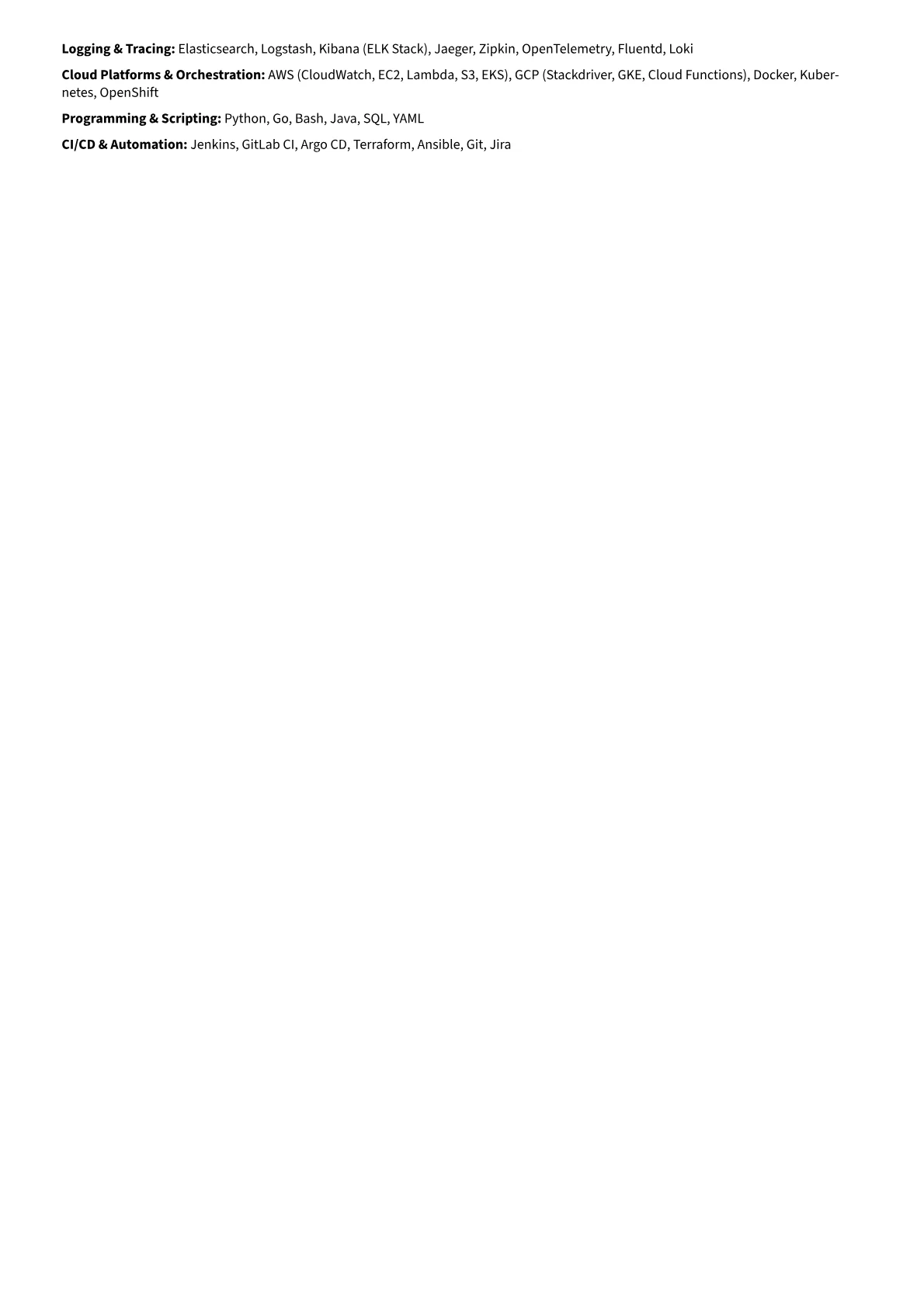
AWS (CloudWatch, EC2, Lambda, S3, EKS)GCP (Stackdriver, GKE, Cloud Functions)DockerKubernetesOpenShift
Programming & Scripting
PythonGoBashJavaSQLYAML
CI/CD & Automation
JenkinsGitLab CIArgo CDTerraformAnsibleGitJira
![How to Write a CV for Tech Applications [2026 Guide]](/thumbnails/cv-for-tech-applications.webp)
![How to Write a CV That Shows Startup Experience [2026 Guide]](/thumbnails/cv-for-startup-engineers.webp)