PDF or DOCX · up to 2MB
Write a business analyst resume that lands interviews. BA resume examples, bullet point formulas for requirements gathering and stakeholder management, skills tables, and ATS tips for every experience level.
Write a prompt engineer resume that gets interviews. Full resume example, summary templates, 10+ experience bullets, technical skills breakdown, and tips for career changers from software engineering, copywriting, data science, and UX research.
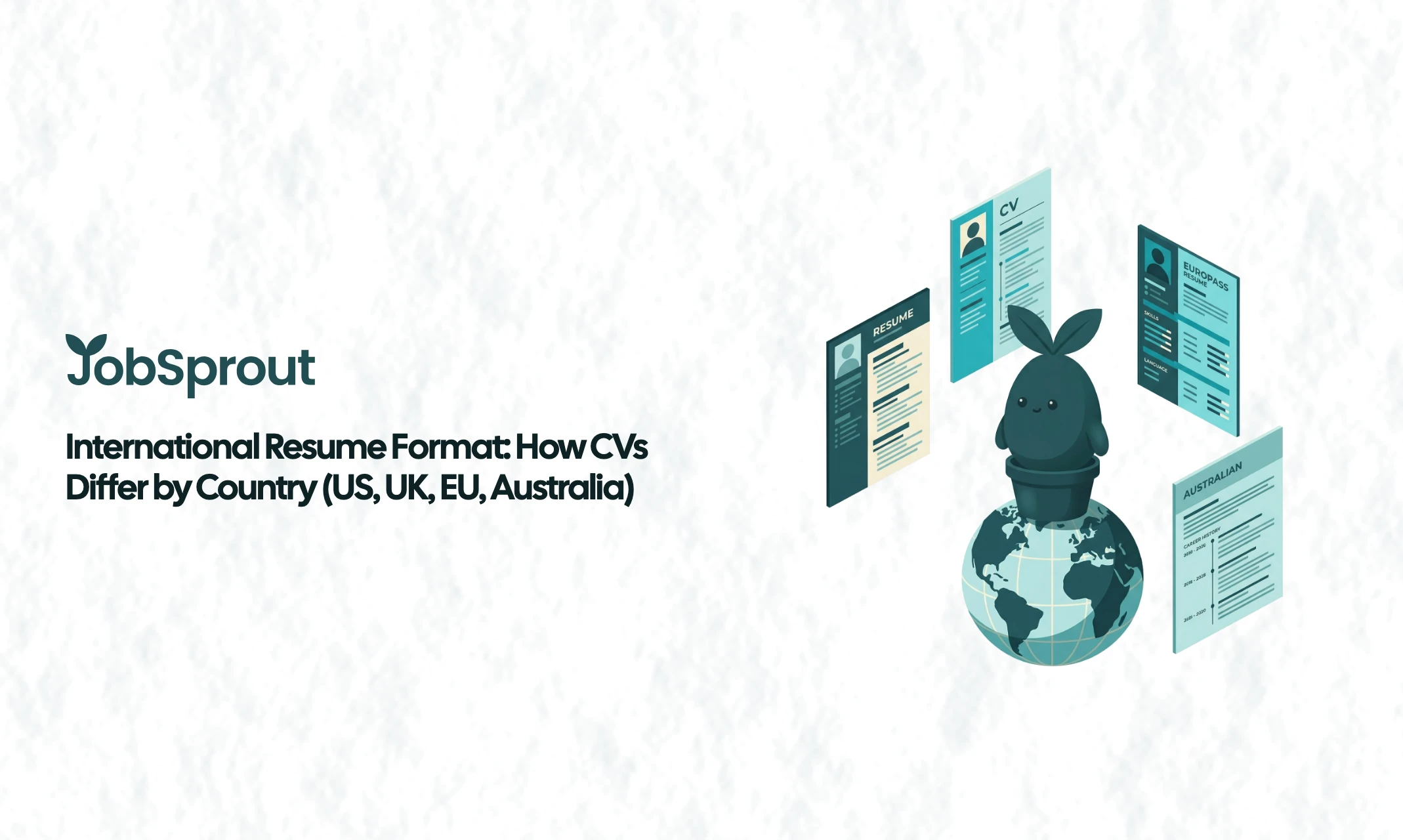
Learn how resume and CV formats differ across countries. Covers the US, UK, Germany, France, Australia, Japan, and the Middle East with comparison tables and practical tips.

Learn how to write a resume for an internal transfer. Includes a full example, summary templates for lateral moves, promotions and department changes, weak vs strong comparisons, and advice on navigating the politics.
Business analysis is one of the most in-demand cross-industry roles in the modern workforce. According to the Bureau of Labor Statistics, demand for management analysts (the category that includes business analysts) is projected to grow 11% through 2032, significantly faster than the average for all occupations. In the UK, business analyst roles consistently rank among the top 20 most-advertised positions on major job boards, with average salaries ranging from £35,000 for junior BAs to over £75,000 for senior and lead analysts.
The challenge? Business analysis is broad. BAs work across finance, healthcare, technology, consulting, government, and virtually every other sector. They gather requirements, map processes, facilitate workshops, write specifications, support UAT, analyse data, and act as the connective tissue between business stakeholders and delivery teams. That breadth makes it difficult to write a resume that feels focused rather than scattered.
Most BA resumes I review suffer from the same problem: they describe activities rather than outcomes. "Gathered business requirements" and "created documentation" appear on nearly every one, but they tell a hiring manager nothing about whether you actually improved anything. In a field where only 2% of resumes result in an interview, vague descriptions will not cut it.
This guide shows you how to write a business analyst resume that proves your impact. I will walk through real examples, a bullet point formula you can use immediately, and the specific details that separate BAs who get interviews from those who do not.
Before writing a single line, it helps to understand what is actually being evaluated. Having reviewed BA resumes as part of hiring processes, I have seen the same themes come up consistently.
1. Evidence of structured thinking
Business analysis is fundamentally about taking ambiguous problems and turning them into structured, actionable solutions. Hiring managers want to see that you can decompose complexity. Resumes that list vague responsibilities ("worked with stakeholders") fail this test. Resumes that show a clear progression from problem to analysis to solution pass it.
2. Stakeholder management skills
A BA who cannot manage stakeholders is a BA who cannot do the job. Hiring managers look for evidence that you have worked across different levels of seniority, managed conflicting priorities, and facilitated agreement. Mentioning specific stakeholder groups (C-suite, product owners, development teams, end users) is far more convincing than generic statements.
3. Measurable outcomes
The strongest BA resumes tie every major responsibility to a result. Did your requirements work reduce rework? Did your process mapping lead to efficiency gains? Did your analysis support a business case that was approved? Numbers matter. Even approximate figures (saved "approximately £50,000 annually") are better than no figures at all.
4. Technical credibility
Modern BAs are expected to be technically literate. Hiring managers want to see that you can write SQL queries, build dashboards, use modelling tools, and work within Agile frameworks. A resume that only lists soft skills will struggle against candidates who demonstrate both business acumen and technical capability.
5. Domain knowledge
While BAs can work across industries, most hiring managers prefer candidates who understand their specific domain. If you are applying to a financial services firm, your resume should emphasise regulatory knowledge, risk analysis, or trading systems experience. Tailor your resume to the industry, not just the role.
Let's look at a real BA resume that demonstrates what works in consulting.
Hannah's resume lands because it leads with specifics, not generalities. Her summary opens with "7 years of experience in the consulting industry" and immediately names her speciality: driving strategic initiatives and optimizing business processes. No filler.
The experience section is where this resume earns its interviews. Every bullet at Deloitte quantifies impact: "5+ large-scale digital transformation projects," "20% average reduction in project scope creep," "95% consensus on critical solution designs." These are the metrics consulting hiring managers scan for.
Her skills section is organized into four clear categories: Business Analysis, Project & Agile Methodologies, Tools & Technologies, and Stakeholder Engagement. This grouping makes it easy for both ATS systems and human reviewers to find what they need.
Here is what Hannah's resume contains, drawn from the real template above.
Her summary follows the formula: role + years + speciality + proof point.
Highly analytical and results-driven Business Analyst with 7 years
of experience in the consulting industry, specializing in driving
strategic initiatives and optimizing business processes. Proven
ability to translate complex business requirements into actionable
solutions, significantly improving operational efficiency and
project outcomes.
This works because it answers "who are you?" and "what do you do?" in two sentences. The phrase "translate complex business requirements into actionable solutions" is exactly the language consulting firms use in their own job descriptions.
Hannah shows clear career progression from Accenture to Deloitte. Her Deloitte bullets demonstrate leadership and scale:
DELOITTE (Senior Business Analyst, 2020 - Present)
- Led requirements gathering for 5+ large-scale digital
  transformation projects, resulting in a 20% average reduction
  in project scope creep and a 15% improvement in deployment
  efficiency
- Designed and implemented new business processes for a retail
  client, decreasing order fulfillment errors by 25% and
  improving customer satisfaction scores by 10%
- Facilitated workshops with 20+ key stakeholders across client
  organizations to align on strategic objectives, achieving 95%
  consensus on critical solution designs
Notice the pattern: Action + Scale + Result. Every bullet tells the reader what she did, at what scale, and what changed because of it.
An MBA from Kellogg with a 3.8 GPA specializing in Strategy and Analytics. Her education section also highlights a consulting project for a Fortune 500 client, reinforcing her applied experience.
Four clean groups covering the full BA toolkit: requirements gathering, Agile/Scrum, SQL/Tableau/Power BI, and stakeholder management. This is the format most hiring managers prefer because it is scannable.
If you want to use this as your starting point, hit "Remix with AI" on the template above. Paste a job description and JobSprout will adapt Hannah's structure to match your target role.
Your professional summary is the first section a hiring manager reads. It should answer three questions in two to four sentences: Who are you? What have you accomplished? What value do you bring?
Here are three examples tailored to different experience levels.
Weak: "Recent graduate looking for a business analyst role. Good communication skills and knowledge of business processes. Eager to learn and grow."
Strong: "Business analyst with 1 year of experience in SaaS product development, specialising in requirements gathering and user story creation. Conducted 30+ stakeholder interviews and documented 85 user stories for an onboarding platform, contributing to a 15% improvement in customer retention. Proficient in SQL, JIRA, and Lucidchart."
The strong version replaces vague self-assessment with specific evidence. Even with limited experience, you can quantify your contributions.
Weak: "Experienced business analyst with strong analytical skills and a background in financial services. Proficient in various tools and methodologies. Looking for a challenging role."
Strong: "CBAP-certified business analyst with 5 years of experience across financial services and insurance. Led requirements gathering for a £4.2M platform migration serving 2M+ customers, reducing claims processing time by 28%. Skilled in stakeholder facilitation, BPMN process modelling, and data analysis using SQL and Power BI."
The strong version names a certification, a headline achievement with a pound figure, and specific technical skills. It gives a hiring manager three reasons to keep reading.
Weak: "Senior business analyst with extensive experience in multiple industries. Strong leadership skills and deep understanding of business processes. Proven track record of delivering projects."
Strong: "Senior business analyst and CBAP holder with 8 years of experience leading requirements delivery for enterprise programmes valued at up to £12M across banking, insurance, and public sector. Built and mentored a team of 4 BAs while maintaining a 96% stakeholder satisfaction rating across 6 concurrent workstreams. Expert in Agile delivery, business process re-engineering, and data-driven decision support using SQL, Python, and Tableau."
At senior level, hiring managers want to see scale (programme size, team leadership, multiple workstreams) alongside technical depth. The strong version delivers both.
The experience section is where most BA resumes either win or lose. Each bullet should follow a simple formula: Action verb + what you did + scale/context + measurable result.
For a comprehensive list of verbs to start your bullets, see our action verbs guide.
Weak: "Responsible for gathering requirements from stakeholders."
Strong: "Elicited and documented 140+ functional requirements across 6 stakeholder groups using workshops, interviews, and document analysis, reducing UAT defects by 35% through improved requirements traceability."
Weak: "Wrote user stories for the development team."
Strong: "Authored 95 user stories with detailed acceptance criteria in JIRA, enabling the development team to deliver 92% of sprint commitments on time across 8 sprints."
Weak: "Worked with various stakeholders across the business."
Strong: "Facilitated 25+ requirements workshops with stakeholders ranging from C-suite executives to frontline operations staff, resolving 18 conflicting requirements through structured prioritisation using MoSCoW analysis."
Weak: "Communicated with the project team regularly."
Strong: "Presented fortnightly progress reports to a steering committee of 8 senior leaders, maintaining 94% stakeholder satisfaction as measured by quarterly feedback surveys."
Weak: "Analysed business processes and suggested improvements."
Strong: "Mapped 14 end-to-end business processes using BPMN notation, identifying 8 bottlenecks in the invoice approval workflow that, once resolved, reduced average processing time from 12 days to 4 days."
Weak: "Helped improve operational efficiency."
Strong: "Designed a TO-BE process model for customer onboarding that eliminated 5 manual handoffs and reduced onboarding time by 42%, saving an estimated £180,000 annually in operational costs."
Weak: "Analysed data and created reports."
Strong: "Built 12 Power BI dashboards tracking customer churn, revenue by segment, and operational throughput, adopted by 4 department heads and used to inform a pricing strategy change that increased margins by 8%."
Weak: "Used SQL to query databases."
Strong: "Wrote complex SQL queries across 6 relational databases to extract, transform, and analyse 3 years of transaction data, identifying a £240,000 revenue leakage in the billing reconciliation process."
Weak: "Supported user acceptance testing."
Strong: "Coordinated UAT across 3 release cycles involving 45 business users, creating 150+ test scenarios mapped to requirements and reducing post-release defects by 40% compared to prior releases."
Weak: "Tested the system before go-live."
Strong: "Designed and executed a UAT strategy for a £2.8M CRM migration, identifying 28 critical defects before go-live and achieving zero P1 incidents in the first 90 days post-launch."
Weak: "Created documentation for the project."
Strong: "Authored comprehensive business requirements documents (BRDs), functional specifications, and data dictionaries for 4 concurrent workstreams, maintaining a requirements traceability matrix with 100% coverage from business need to delivered feature."
Weak: "Documented processes and procedures."
Strong: "Developed a standardised BA deliverables framework adopted across 3 project teams, reducing document review cycles by 30% and establishing a reusable template library of 15 artefacts."
Each of these examples follows the same pattern: a specific action, a clear scope, and a measurable outcome. Even if your exact numbers differ, the structure will make your bullets significantly more compelling.
Your skills section should balance technical tools with business analysis methodologies. Here is a breakdown of what to include and how to frame it.
| Skill Category | Specific Skills | Why It Matters |
|---|---|---|
| Data & Analytics | SQL, Excel (advanced), Power BI, Tableau, Python (pandas) | BAs increasingly need to query data directly rather than relying on analysts. SQL and a visualisation tool are near-universal requirements. |
| Requirements Tools | JIRA, Confluence, Azure DevOps, IBM DOORS | Demonstrates you can manage requirements in enterprise tooling, not just spreadsheets. |
| Process Modelling | BPMN, UML (use case, activity, sequence diagrams), Visio, Lucidchart | Core BA competency. Hiring managers want to see specific notation knowledge, not just "process mapping." |
| Agile & Delivery | Scrum, Kanban, SAFe, sprint planning, backlog refinement | Most BA roles now sit within Agile teams. Naming the specific framework shows you understand the nuances. |
| Business Process Modelling | Lean Six Sigma, value stream mapping, gap analysis, root cause analysis | Shows you can go beyond documentation into genuine process improvement. |
| Prototyping & Design | Figma, Balsamiq, Axure, wireframing | Especially valuable for digital/product BA roles where early visual validation reduces rework. |
| Communication & Facilitation | Workshop facilitation, MoSCoW prioritisation, stakeholder mapping, presentation | Soft skills are critical for BAs, but name the specific techniques rather than listing "good communication skills." |
Avoid rating your skills with bars, percentages, or star ratings. They are meaningless without context and can actually hurt you (is 70% in SQL good or bad?). Instead, demonstrate proficiency through your experience bullets. If you wrote complex SQL queries across 6 databases, the hiring manager understands your level without a progress bar.
While the core BA skill set is transferable, the emphasis shifts significantly by industry. Here is how to tailor your resume for four of the most common BA sectors.
Financial services BAs work with complex regulatory environments, large-scale data, and risk-sensitive processes. Your resume should emphasise:
Example bullet: "Documented business requirements for a PSD2-compliant open banking API serving 1.4M retail customers, coordinating with compliance, IT security, and 3 third-party payment providers to achieve regulatory approval 4 weeks ahead of deadline."
Healthcare BAs navigate clinical workflows, patient data sensitivity, and complex stakeholder ecosystems (clinicians, administrators, IT, patients). Focus on:
Example bullet: "Led requirements analysis for an electronic patient record (EPR) integration across 4 hospital sites, mapping 22 clinical workflows and reducing duplicate data entry by 60%, saving nursing staff an estimated 15 hours per week."
In tech companies, BAs often overlap with product management. The emphasis shifts toward user experience, product metrics, and rapid iteration. Highlight:
Example bullet: "Defined requirements for a self-service analytics feature through 20 user interviews and 3 rounds of prototype testing, contributing to a 34% increase in daily active users within 8 weeks of launch."
Consulting BAs need to demonstrate adaptability, rapid onboarding, and client management. Your resume should show:
Example bullet: "Delivered a 6-week business process review for a FTSE 250 retailer, mapping 18 supply chain processes and presenting 12 improvement recommendations to the CFO, 4 of which were approved for immediate implementation with projected savings of £450,000 annually."
Certifications can strengthen a BA resume, particularly when you are moving between industries or competing for senior roles. Here is a breakdown of the most recognised options.
| Certification | Issuing Body | Experience Required | Best For |
|---|---|---|---|
| CBAP (Certified Business Analysis Professional) | IIBA | 7,500 hours of BA work over 10 years | Senior BAs looking to validate deep expertise. The gold standard for dedicated business analysts. |
| CCBA (Certification of Capability in Business Analysis) | IIBA | 3,750 hours of BA work over 7 years | Mid-level BAs with 3-5 years of experience. A strong stepping stone toward CBAP. |
| PMI-PBA (Professional in Business Analysis) | PMI | 4,500 hours of BA work (or 7,500 without a degree) | BAs who work closely with project managers or within PMI-aligned organisations. |
| ECBA (Entry Certificate in Business Analysis) | IIBA | 21 hours of professional development | Junior BAs or career changers. No work experience required. |
| PSM I / CSM (Scrum Master certifications) | Scrum.org / Scrum Alliance | None (exam-based) / 2-day course | BAs working in Agile teams who want to demonstrate Scrum fluency. |
| SAFe Agilist | Scaled Agile | None (course + exam) | BAs in large enterprises using Scaled Agile Framework. |
| Six Sigma Green/Black Belt | Various (ASQ, IASSC) | Varies | BAs focused on process improvement and operational excellence. |
Certifications are most valuable in three scenarios:
They are least valuable when you already have strong experience and a track record of measurable results. A CBAP on top of 8 years of proven delivery is a nice addition. A CBAP on top of a vague resume will not fix the underlying problem.
Place certifications in a dedicated section below education, listing the certification name, issuing body, and year obtained. If you are currently pursuing one, list it as "In progress, expected [month year]."
After reviewing hundreds of BA resumes, these are the mistakes I see most frequently.
1. Listing activities instead of outcomes
This is the single most common problem. "Gathered requirements," "created documentation," and "facilitated meetings" describe what every BA does. They say nothing about whether you did it well. Always tie activities to results: what changed because of your work?
2. Being too generic across industries
A resume that tries to appeal to every industry appeals strongly to none. If you are applying to a healthcare company, foreground your healthcare experience. If you are applying to a bank, lead with financial services. You do not need to rewrite the entire resume, but your summary and top bullets should clearly align with the target domain.
3. Ignoring technical skills
Some BAs position themselves as pure "business-side" professionals and leave technical skills off entirely. In 2026, this is a significant disadvantage. Even if you are not writing code, hiring managers expect you to be comfortable with SQL, data visualisation tools, and Agile tooling. If you have these skills, make them visible.
4. Using a functional resume format
Functional resumes (which group skills by category rather than by role) are almost always a bad choice for BAs. Hiring managers want to see your career progression and understand what you did at each company. Reverse-chronological is the format most hiring managers prefer, and for good reason.
5. Overselling Agile experience
Attending daily stand-ups does not make you an Agile expert. If your Agile experience is limited, be honest about it. "Participated in Scrum ceremonies within a 10-person squad" is better than claiming to be an "Agile transformation leader" when you were not. Exaggeration is easy to spot in interviews and erodes trust quickly.
6. Writing a two-page resume when one page will do
If you have fewer than 5 years of experience, aim for one page. If you have 5-10 years, two pages are acceptable. Beyond that, still aim for two pages but be ruthless about what you include. Roles from more than 10 years ago can be summarised in one or two lines. Nobody needs to see the detailed bullets from your 2014 internship.
7. Neglecting the summary section
Some BAs skip the summary entirely, jumping straight into experience. This forces the hiring manager to piece together your profile from individual bullets. A well-written summary saves them time and frames everything that follows. For guidance on writing one, see our resume summary examples.
Most large employers use applicant tracking systems (ATS) to screen resumes before a human ever sees them. If your resume does not contain the right keywords, it may never reach a hiring manager. For a deeper dive into how ATS systems work, see our ATS-friendly resume guide.
Here are the keywords that appear most frequently in BA job descriptions, grouped by category.
Core BA Terms
Process and Modelling
Agile and Delivery
Technical
Stakeholder and Communication
Do not simply dump keywords into your resume. Instead, weave them naturally into your experience bullets and skills section. ATS systems are increasingly sophisticated and can detect keyword stuffing. The goal is to use the language of the job description while still writing compelling, human-readable content.
A practical approach: for each job you apply to, compare the job description against your resume and ensure you have covered at least 70-80% of the key terms mentioned. If a job description repeatedly mentions "stakeholder management" and your resume says "worked with various teams," you are leaving points on the table.
Tools like JobSprout can help you tailor your resume to specific job descriptions, rewriting your experience to match the language and requirements of specific job descriptions. This is especially useful when applying to multiple roles across different industries where the terminology shifts.
Writing a strong business analyst resume comes down to three principles: be specific about what you did, quantify the impact wherever possible, and tailor the content to the role and industry you are targeting.
Start with your summary. Make it count by including your years of experience, a headline achievement, and your core technical skills. Then work through your experience section bullet by bullet, applying the formula: action verb, what you did, scale or context, and measurable result. Fill your skills section with the tools and methodologies you actually use, and include certifications if they are relevant to your target role.
If you are unsure whether your resume is hitting the mark, try reading each bullet and asking: "Would a hiring manager know I was good at this job based on this sentence alone?" If the answer is no, revise it.
For more guidance on writing effective resume content, explore our guides on action verbs, resume skills, and how to tailor your resume to a job description. And if you want to speed up the process, JobSprout can generate a tailored BA resume from your existing CV and a job description in minutes.
Business analysis is a role that rewards clarity, structure, and evidence-based thinking. Your resume should demonstrate all three.